Train AI models with Unsloth and Hugging Face Jobs for FREE
This blog post covers how to use Unsloth and Hugging Face Jobs for fast LLM fine-tuning (specifically LiquidAI/LFM2.5-1.2B-Instruct ) through coding agents like Claude Code and Codex. Unsloth provides ~2x faster training and ~60% less VRAM usage compared to standard methods, so training small models can cost just a few dollars.
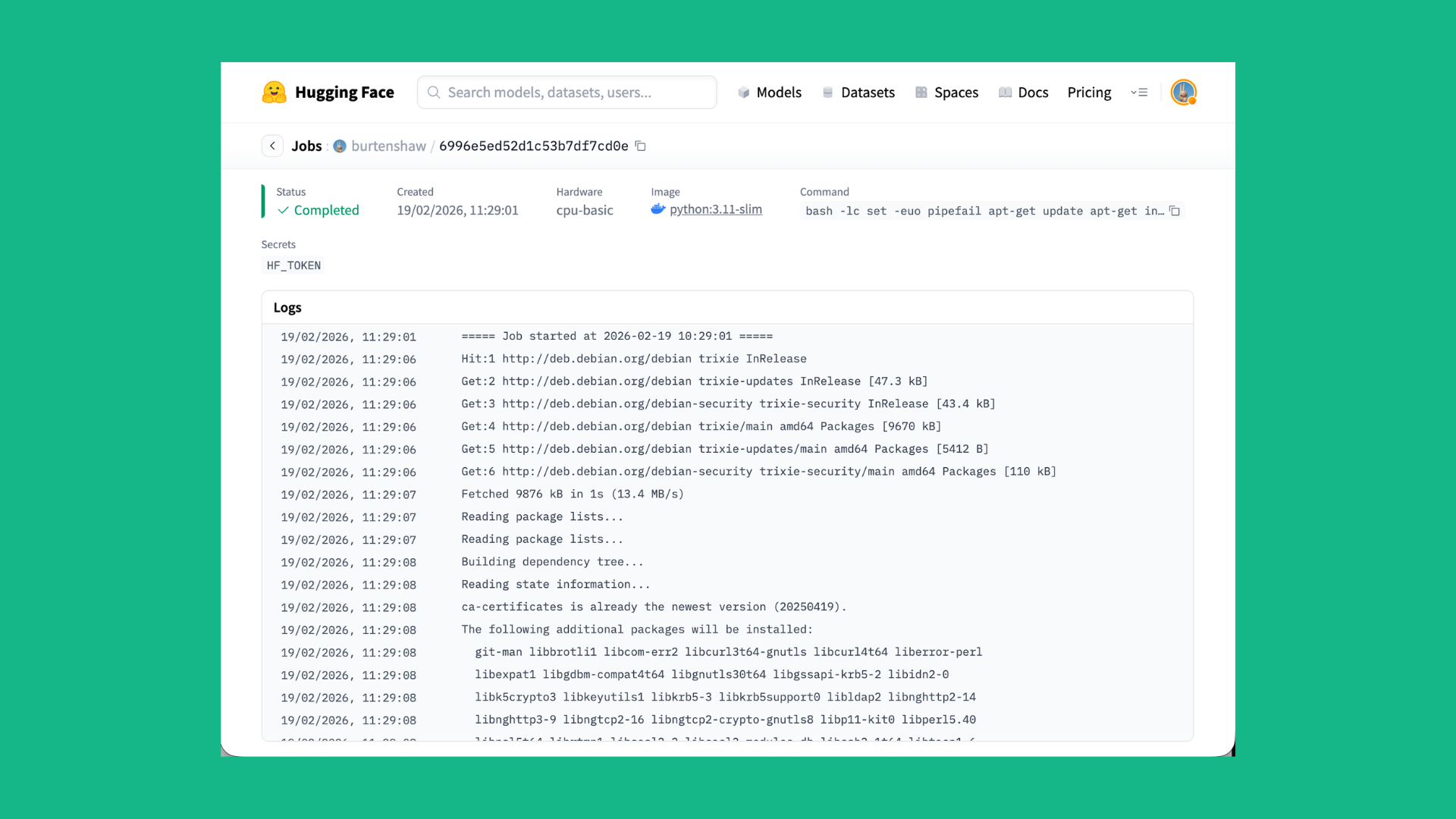
You will need
We are giving away free credits to fine-tune models on Hugging Face Jobs. Join the Unsloth Jobs Explorers organization to claim your free credits and one-month Pro subscription.
A Hugging Face account (required for HF Jobs)
Billing setup (for verification, you can monitor your usage and manage your billing in your billing page).
A Hugging Face token with write permissions
(optional) A coding agent (
Open Code,Claude Code, orCodex)
Run the Job
If you want to train a model using HF Jobs and Unsloth, you can simply use the hf jobs CLI to submit a job.
First, you need to install the hf CLI. You can do this by running the following command:
# mac or linux
curl -LsSf https://hf.co/cli/install.sh | bash
Next you can run the following command to submit a job:
hf jobs uv run https://huggingface.co/datasets/unsloth/jobs/resolve/main/sft-lfm2.5.py \
    --flavor a10g-small  \
    --secrets HF_TOKEN  \
    --timeout 4h \
    --dataset mlabonne/FineTome-100k \
    --num-epochs 1 \
    --eval-split 0.2 \
    --output-repo your-username/lfm-finetuned
Check out the training script and Hugging Face Jobs documentation for more details.
Installing the Skill
Hugging Face model training skill lowers barrier of entry to train a model by simply prompting. First, install the skill with your coding agent.
Claude Code
Claude Code discovers skills through its plugin system, so we need to install the Hugging Face skills first. To do so:
Add the marketplace:
/plugin marketplace add huggingface/skillsBrowse available skills in the
Discovertab:
/pluginInstall the model trainer skill:
/plugin install hugging-face-model-trainer@huggingface-skillsFor more details, see the documentation on using the hub with skills or the Claude Code Skills docs.
Codex
Codex discovers skills through AGENTS.md files and .agents/skills/ directories.
Install individual skills with $skill-installer:
$skill-installer install https://github.com/huggingface/skills/tree/main/skills/hugging-face-model-trainerFor more details, see the Codex Skills docs and the AGENTS.md guide.
Anything else
A generic install method is simply to clone the skills repository and copy the skill to your agent's skills directory.
git clone https://github.com/huggingface/skills.git
mkdir -p ~/.agents/skills && cp -R skills/skills/hugging-face-model-trainer ~/.agents/skills/
Quick Start
Once the skill is installed, ask your coding agent to train a model:
Train LiquidAI/LFM2.5-1.2B-Instruct on mlabonne/FineTome-100k using Unsloth on HF JobsThe agent will generate a training script based on an example in the skill, submit the training to HF Jobs, and provide a monitoring link via Trackio.
How It Works
Training jobs run on Hugging Face Jobs, fully managed cloud GPUs. The agent:
Generates a UV script with inline dependencies
Submits it to HF Jobs via the
hfCLIReports the job ID and monitoring URL
Pushes the trained model to your Hugging Face Hub repository
Example Training Script
The skill generates scripts like this based on the example in the skill.
# /// script
# dependencies = ["unsloth", "trl>=0.12.0", "datasets", "trackio"]
# ///

from unsloth import FastLanguageModel
from trl import SFTTrainer, SFTConfig
from datasets import load_dataset

model, tokenizer = FastLanguageModel.from_pretrained(
    "LiquidAI/LFM2.5-1.2B-Instruct",
    load_in_4bit=True,
    max_seq_length=2048,
)

model = FastLanguageModel.get_peft_model(
    model,
    r=16,
    lora_alpha=32,
    lora_dropout=0,
    target_modules=[
        "q_proj",
        "k_proj",
        "v_proj",
        "out_proj",
        "in_proj",
        "w1",
        "w2",
        "w3",
    ],
)

dataset = load_dataset("trl-lib/Capybara", split="train")

trainer = SFTTrainer(
    model=model,
    tokenizer=tokenizer,
    train_dataset=dataset,
    args=SFTConfig(
        output_dir="./output",
        push_to_hub=True,
        hub_model_id="username/my-model",
        per_device_train_batch_size=4,
        gradient_accumulation_steps=4,
        num_train_epochs=1,
        learning_rate=2e-4,
        report_to="trackio",
    ),
)

trainer.train()
trainer.push_to_hub()
Model Size
Recommended GPU
Approx Cost/hr
<1B params
t4-small
~$0.40
1-3B params
t4-medium
~$0.60
3-7B params
a10g-small
~$1.00
7-13B params
a10g-large
~$3.00
For a full overview of Hugging Face Spaces pricing, check out the guide here.
Tips for Working with Coding Agents
Be specific about the model and dataset to use, and include Hub IDs (for example,
Qwen/Qwen2.5-0.5Bandtrl-lib/Capybara). Agents will search for and validate those combinations.Mention Unsloth explicitly if you want it used. Otherwise, the agent will choose a framework based on the model and budget.
Ask for cost estimates before launching large jobs.
Request Trackio monitoring for real-time loss curves.
Check job status by asking the agent to inspect logs after submission.