Bringing Nunchaku 4-bit Diffusion Inference to Diffusers
Large diffusion transformers can create stunning images (or even videos, audio snippets, and now text), but loading a modern text-to-image model in BF16 precision often requires 20-30 GB of VRAM, which puts these models out of reach of most consumer GPUs. Quantization is a powerful solution to this problem, and Diffusers already integrates several quantization backends such as bitsandbytes, GGUF, torchao, and Quanto, which we covered in Exploring Quantization Backends in Diffusers.
Most of these backends are weight-only. This means that they store the weights in low precision and dequantize them back to high precision at compute time. This reduces memory usage significantly, but it usually does not make inference faster, and can even add a small latency overhead.
SVDQuant, the quantization method behind the popular Nunchaku inference engine, takes a different approach. It runs the main transformer layers with 4-bit weights and activations (W4A4), reducing memory while also speeding up the denoising loop. The details are covered below, but until now, using these checkpoints required a separate inference library.
With current Diffusers, loading a Nunchaku checkpoint is as simple as calling from_pretrained(), with no local CUDA compilation required thanks to the kernels package. In addition, the companion diffuse-compressor toolkit lets you quantize new architectures yourself and publish them as regular Diffusers repositories.
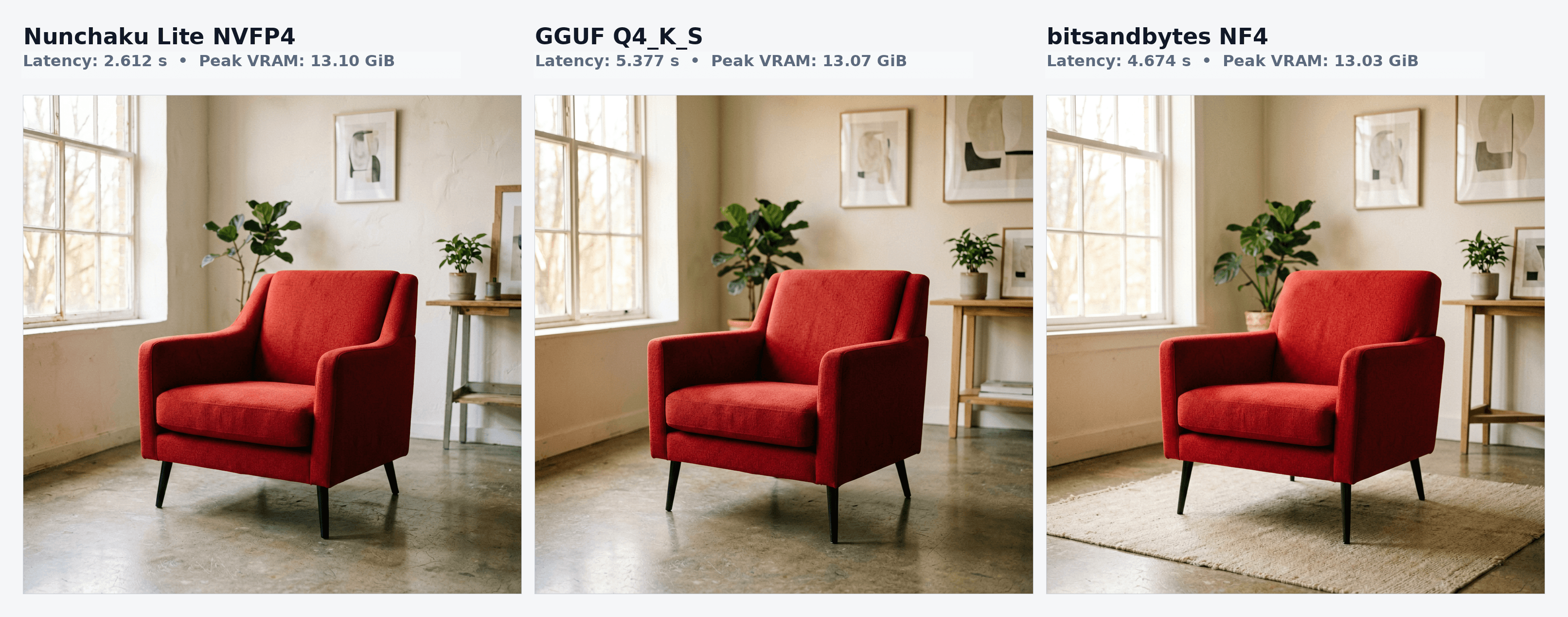
Table of Contents
Getting started with Nunchaku Lite
First, install the requirements. You need a recent version of Diffusers and the Hugging Face kernels package:
pip install -U diffusers transformers accelerate kernels bitsandbytesThen load a pre-quantized pipeline like any other Diffusers model:
import torch
from diffusers import ErnieImagePipeline

pipe = ErnieImagePipeline.from_pretrained(
    "lite-infer/ERNIE-Image-Turbo-nunchaku-lite-nvfp4_r32-bnb4-text-encoder",
    torch_dtype=torch.bfloat16,
).to("cuda")

image = pipe(
    prompt="A cinematic portrait of a red fox in a misty forest at sunrise, "
           "detailed fur, volumetric light",
    height=1024,
    width=1024,
    num_inference_steps=8,
    guidance_scale=1.0,
    generator=torch.Generator("cuda").manual_seed(42),
).images[0]
image.save("output.png")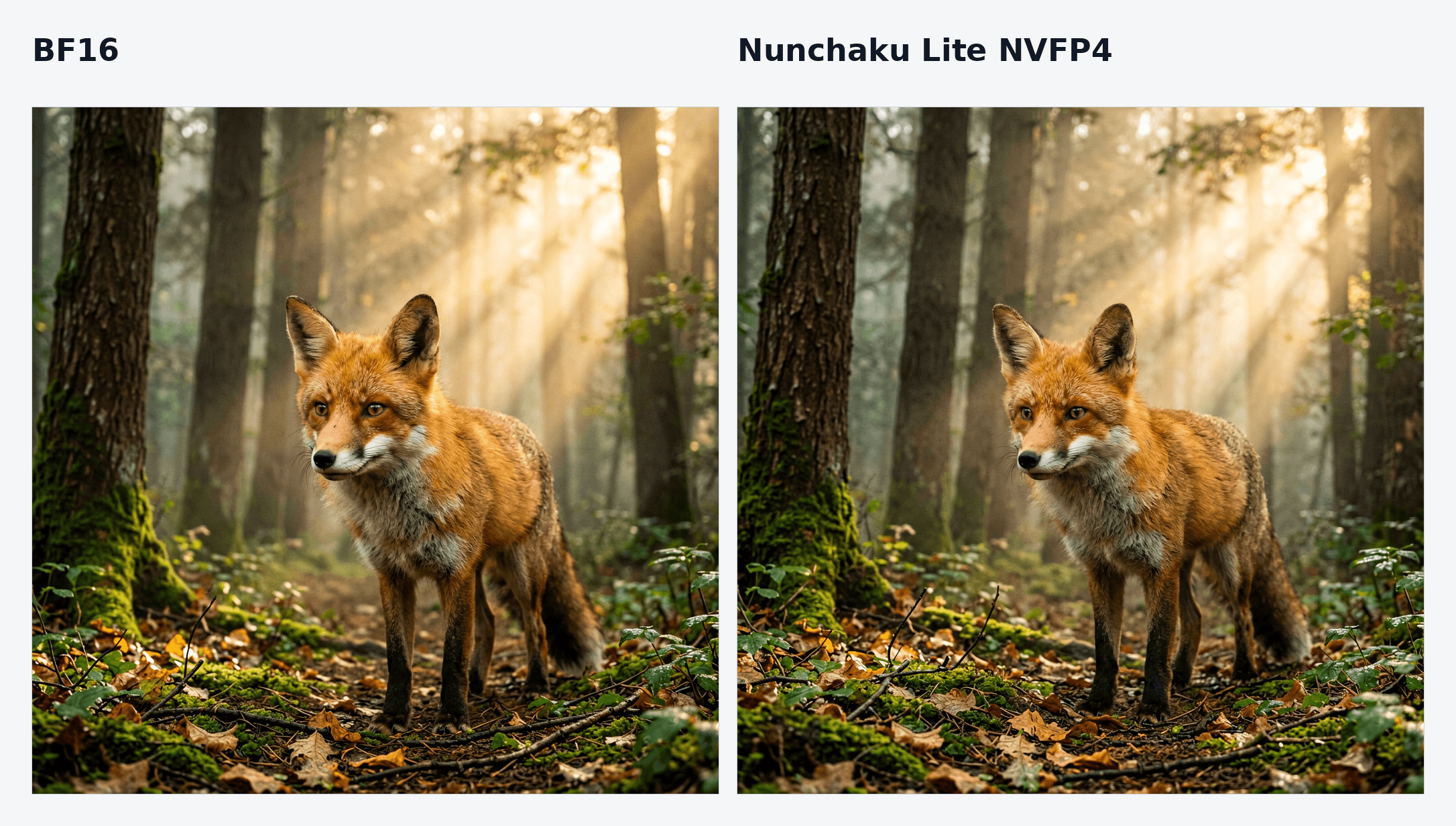
NVFP4 checkpoints require an NVIDIA Blackwell GPU (RTX 50 series, RTX PRO 6000, B200). For earlier generations, use the INT4 variants. See the hardware support table below for details.
Background: SVDQuant and Nunchaku
SVDQuant is the quantization method behind Nunchaku, its reference CUDA inference engine. Standard 4-bit quantization is difficult for diffusion transformers because both weights and activations contain large outliers. SVDQuant handles this by moving activation outliers into the weights, representing the hardest part of each weight matrix with a small 16-bit low-rank branch, and quantizing the remaining residual to 4 bits. Nunchaku makes this fast with fused kernels for the 4-bit path and the low-rank branch.
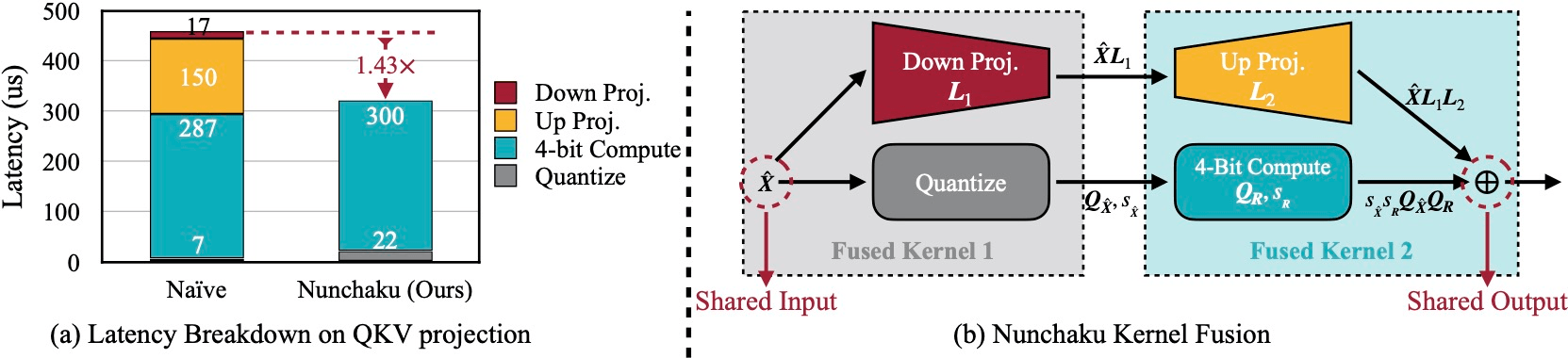
Nunchaku fuses the low-rank down projection with the quantization kernel and the low-rank up projection with the 4-bit compute kernel, eliminating the memory access overhead of the 16-bit branch. Figure from the SVDQuant paper.
Introducing Nunchaku Lite
The original Nunchaku engine gets much of its speed from model-specific fused execution paths, such as fused QKV projections and fused GELU/MLP kernels. Those optimizations are tied to each architecture's module layout and checkpoint format, so supporting a new model family usually requires model-specific integration work.
Nunchaku Lite is the new integration path in Diffusers. With it, Diffusers can load Nunchaku-style checkpoints without a custom pipeline or a separate inference engine. Under the hood, Nunchaku Lite patches the relevant nn.Linear modules of a stock Diffusers model with runtime SVDQ/AWQ linear layers before the checkpoint is loaded. The CUDA kernels come from the Hub through the kernels package. Two kernel families are used:
svdq_w4a4: 4-bit weights and activations with the SVDQuant low-rank correction. This layer is used for the transformer's attention and MLP projections, where nearly all of the compute is spent, and is available in INT4 and NVFP4 variants.awq_w4a16: 4-bit weights with 16-bit activations, used for adaptive normalization and modulation projections such as FLUXadanorm_single/adanorm_zeroor Qwen-Image modulation layers. These layers are memory-bound and precision-sensitive, making AWQ a good fit to preserve precision while still saving memory and space.
The trade-off is that, without architecture-specific fused kernels and modules, Nunchaku Lite cannot match the speedup of the original Nunchaku engine. However, the bare-bones implementation still delivers around 30% speedup while retaining the same level of VRAM reduction.
Native loading in Diffusers
If you have used bitsandbytes or torchao in Diffusers, the mechanics will feel familiar. A Nunchaku Lite model repository is an ordinary Diffusers repository. The only special part is a quantization_config block inside the transformer's config.json:
"quantization_config": {
    "quant_method": "nunchaku_lite",
    "compute_dtype": "bfloat16",
    "svdq_w4a4": {
        "precision": "nvfp4",
        "group_size": 16,
        "rank": 32,
        "targets": [
            "layers.0.self_attention.to_q",
            "layers.0.self_attention.to_k",
            "..."
        ]
    },
    "awq_w4a16": {
        "precision": "int4",
        "group_size": 64,
        "targets": [
            "adaLN_modulation.1",
            "..."
        ]
    }
}
This config tells Diffusers which modules were quantized, which scheme they use, and which Nunchaku Lite runtime layer to instantiate (SVDQW4A4Linear or AWQW4A16Linear).
Because the quantized model keeps the exact module structure of the dense one, everything downstream (schedulers, LoRA loading hooks, offloading, torch.compile) sees a normal Diffusers model.
Hardware support
Nunchaku Lite uses different kernel variants depending on the GPU generation and checkpoint precision:
Scheme
Precision
Supported GPUs
svdq_w4a4
nvfp4
Blackwell (RTX 50 series, RTX PRO 6000, B200)
svdq_w4a4
int4
Turing / Ampere / Ada (RTX 30 & 40 series, A100, L40S)
awq_w4a16
int4
Turing / Ampere / Ada (RTX 30 & 40 series, A100, L40S)
Volta and Hopper GPUs are currently not supported by the 4-bit kernels. The quantizer validates the GPU's CUDA capability at load time and raises a clear error instead of producing incorrect outputs.
Getting more speed and lower memory
Nunchaku Lite can be combined with other Diffusers memory and speed optimizations.
torch.compile. Compiling the transformer improves the end-to-end speedup from 1.35x to 1.8x:
pipe.transformer.compile(fullgraph=True)

# or compile_repeated_blocks() for faster compilation

pipe.transformer.compile_repeated_blocks(fullgraph=True)
Quantized text encoders. The transformer is not the only component with a large memory footprint. Text encoders such as T5 or Qwen3 can occupy several gigabytes on their own. Further quantizing the text encoder with bitsandbytes NF4 reduces peak VRAM by about 22% in our benchmark.
Offloading. Diffusers offloading helpers such as enable_model_cpu_offload() and enable_sequential_cpu_offload() work as usual if you need to fit the pipeline onto a smaller GPU.
Benchmarks
All numbers below were measured on an NVIDIA RTX PRO 6000 (Blackwell) at 1024x1024 using rootonchair/ERNIE-Image-Turbo-nunchaku-lite-int4-bnb4-text-encoder.
End-to-end latency and memory
Configuration
Full pipeline
Denoise loop
Peak VRAM
Speedup
BF16 baseline
3.00 s
2.86 s
31.1 GB
1.0x
Nunchaku Lite NVFP4
2.27 s
2.13 s
20.6 GB
1.35x
Nunchaku Lite NVFP4 + torch.compile
1.68 s
1.53 s
20.6 GB
1.8x
Nunchaku Lite NVFP4 + NF4 text encoder
2.29 s
2.13 s
16.0 GB
1.35x
As shown above, Nunchaku reduces peak VRAM by up to 50% while still improving latency by roughly 30%. The remaining overhead comes largely from extra kernel launches, which torch.compile can mitigate, bringing the full pipeline down to 1.68 s, or 1.8x faster than the BF16 baseline.
Image quality
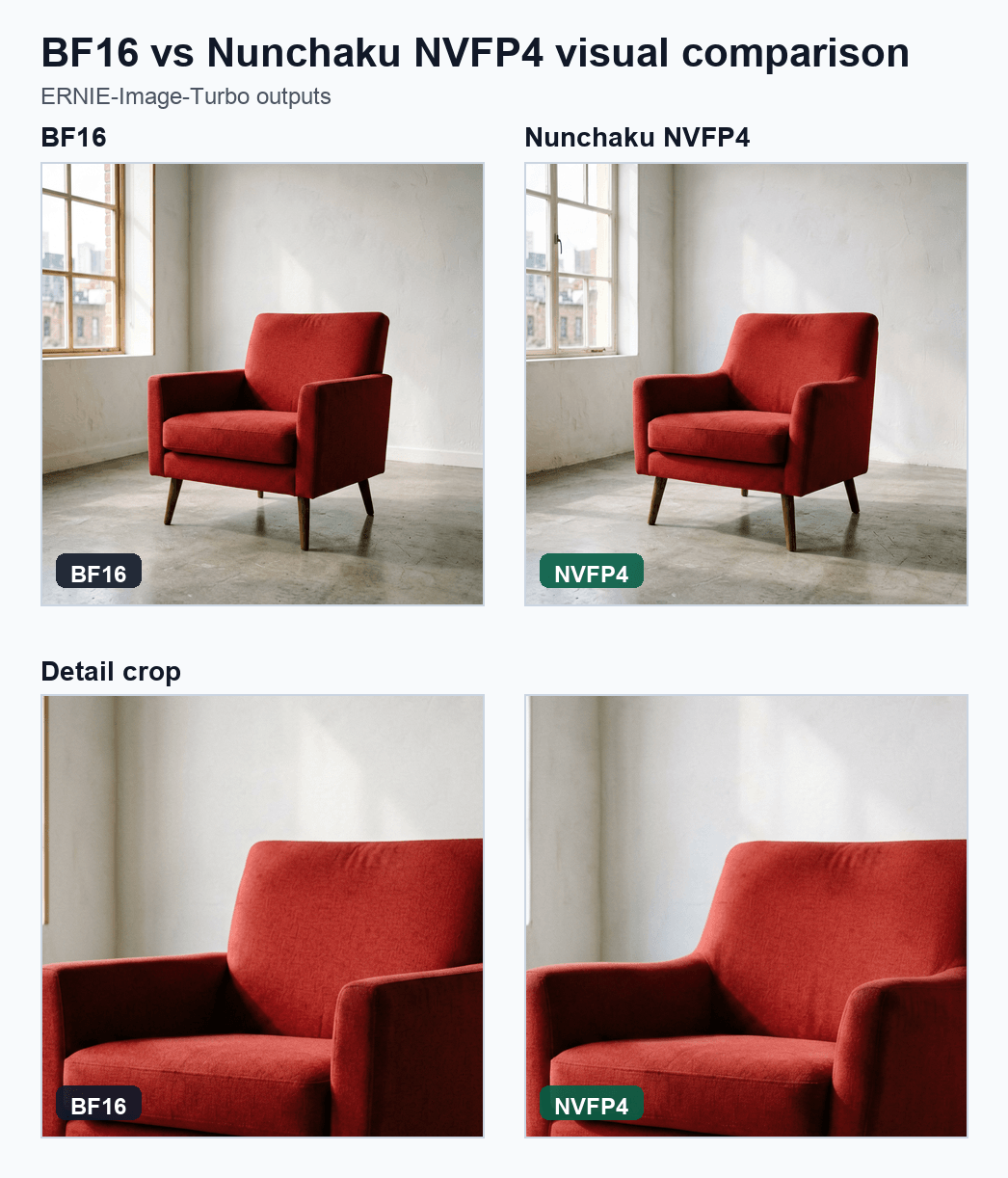
BF16 vs 4-bit outputs with identical seeds and settings.
Quantizing your own model
Nunchaku Lite support in Diffusers is architecture-agnostic, and the diffuse-compressor toolkit provides an end-to-end SVDQuant workflow for Diffusers models: calibrate, quantize, package, and publish.
Below, we walk through quantizing FLUX.2 Klein 4B as an example. It covers the main steps: inspect the model, calibrate and quantize the transformer, package the result as a Diffusers pipeline, then verify and push it to the Hub. The full tutorial covers every flag in detail.
1. Inspect what will be quantized
The generic scanner walks the model and decides what to target: compatible linears inside the repeated transformer-block stack become SVDQ W4A4 targets, recognized modulation linears become AWQ W4A16 targets, and everything else stays dense.
python examples/text_to_image/quantize_hf.py black-forest-labs/FLUX.2-klein-4B \
  --precision int4 --rank 32 --inspect-config
Always read this report before quantizing. For FLUX.2 Klein 4B, the expected result is 100 SVDQ targets, 3 AWQ targets, and 6 dense outer linears, with no missing patterns or duplicate names.
2. Run quantization
The following command runs SVDQuant on the transformer and writes the quantized checkpoint to outputs/checkpoints/svdq-int4_r32-flux-2-klein-4b.safetensors:
python examples/text_to_image/quantize_hf.py black-forest-labs/FLUX.2-klein-4B \
  --precision int4 \
  --output outputs/checkpoints/svdq-int4_r32-flux-2-klein-4b.safetensors
Replace --precision int4 with nvfp4 to build Blackwell-native weights.
3. Package a Diffusers pipeline
The converter combines the quantized transformer with the base pipeline's other components, writes the compact nunchaku_lite configuration into transformer/config.json, and can optionally convert text encoders to NF4:
python examples/convert_nunchaku_lite_diffusers.py \
  --checkpoint outputs/checkpoints/svdq-int4_r32-flux-2-klein-4b.safetensors \
  --model-id black-forest-labs/FLUX.2-klein-4B \
  --bnb4-text-encoder text_encoder \
  --compute-dtype bfloat16 \
  --output-dir outputs/diffusers/FLUX.2-klein-4B-nunchaku-lite-int4-bnb4-text-encoder
4. Load, verify, and push to the Hub
import torch
from diffusers import DiffusionPipeline

pipe = DiffusionPipeline.from_pretrained(
    "outputs/diffusers/FLUX.2-klein-4B-nunchaku-lite-int4-bnb4-text-encoder",
    device_map="cuda",
)
image = pipe(
    "A glass robot in a greenhouse, cinematic lighting",
    num_inference_steps=4, guidance_scale=1.0,
    generator=torch.Generator("cuda").manual_seed(12345),
).images[0]
Once the outputs look good, run pipe.push_to_hub("your-name/your-model-nunchaku-lite-int4"). Other users can then load it with the same from_pretrained() pattern shown above.
Quantizing models with structural rewrites
Note that the generic path assumes the architecture can be quantized without structural rewrites. For additional speedup, the original Nunchaku engine rewrites groups of Diffusers layers as fused modules. The generic path cannot infer these changes on its own, such as combining separate Q, K, and V projections into one module or splitting a fused projection across several modules.
FLUX.1-dev's QKV projection is a concrete example. Diffusers defines three separate modules:
self.to_q = torch.nn.Linear(query_dim, self.inner_dim, bias=bias)
self.to_k = torch.nn.Linear(query_dim, self.inner_dim, bias=bias)
self.to_v = torch.nn.Linear(query_dim, self.inner_dim, bias=bias)
The Nunchaku FLUX module combines those layers into one quantized to_qkv module:
to_qkv = fuse_linears([other.to_q, other.to_k, other.to_v])
self.to_qkv = SVDQW4A4Linear.from_linear(to_qkv, **kwargs)
This grouped module is required because Nunchaku's fused operator consumes the QKV projection, Q/K normalization, and rotary embeddings together. By comparison, the default Diffusers path executes them separately:
query = attn.to_q(hidden_states)
key = attn.to_k(hidden_states)
value = attn.to_v(hidden_states)

query = query.unflatten(-1, (attn.heads, -1))
key = key.unflatten(-1, (attn.heads, -1))
value = value.unflatten(-1, (attn.heads, -1))

query = attn.norm_q(query)
key = attn.norm_k(key)

if image_rotary_emb is not None:
    query = apply_rotary_emb(query, image_rotary_emb, sequence_dim=1)
    key = apply_rotary_emb(key, image_rotary_emb, sequence_dim=1)
The Nunchaku path supplies the grouped projection, normalization modules, and rotary embeddings to one fused operator:
qkv = fused_qkv_norm_rottary(
    hidden_states, attn.to_qkv, attn.norm_q, attn.norm_k, image_rotary_emb
)
This is the structural rewrite that the generic path cannot infer. Diffusers has three destination modules with to_q, to_k, and to_v parameter prefixes, while Nunchaku has one grouped module under to_qkv. A model-specific target config or adapter must state that the Q, K, and V parameters should be concatenated along the output dimension, in that order, and loaded into to_qkv.
Structural rewrites like these are described by a model-specific target config during quantization and handled by a small runtime adapter when the checkpoint is loaded. The FLUX.2 Klein 4B quantization script provides a concrete target-config example for producing a structurally rewritten checkpoint, while rootonchair/nunchaku-lite provides the runtime adapters needed to load grouped QKV tensors, split fused projections, and other fused operations. For the complete workflow, you can check the Adding A New Model guide.
Ready-to-use checkpoints
To get started right away, check out the following repositories:
rootonchair/ERNIE-Image-Turbo-nunchaku-lite-int4-bnb4-text-encoder: INT4 ERNIE-Image-Turbo with a bitsandbytes NF4 text encoder
rootonchair/ERNIE-Image-Turbo-nunchaku-lite-nvfp4-bnb4-text-encoder: NVFP4 ERNIE-Image-Turbo with a bitsandbytes NF4 text encoder
OzzyGT/Krea_2_Turbo_nunchaku_lite_nvfp4: NVFP4 Krea 2 Turbo checkpoint
lite-infer: more Nunchaku Lite checkpoints and collections
Conclusion
Nunchaku's SVDQuant kernels are one of the most effective ways to run diffusion transformers efficiently on consumer hardware, and they are now natively supported in Diffusers. Pre-quantized checkpoints load with from_pretrained(), and the diffuse-compressor toolkit makes it possible to quantize new architectures without waiting for engine support. By quantizing both weights and activations, the W4A4 path lowers memory use while improving denoising latency, keeping image quality close to the BF16 original.
If you quantize and publish a new model, we would love to hear about it. Share it on the Hub and let us know! If you have any questions about this feature, feel free to join our Discord.
To learn more, check out the following resources:
SVDQuant paper and the Nunchaku engine
Previous posts: Exploring Quantization Backends in Diffusers and Memory-efficient Diffusion Transformers with Quanto and Diffusers
Acknowledgements
Thanks to the Diffusers maintainers for reviews and guidance throughout the integration, and to the MIT HAN Lab / Nunchaku team for the original SVDQuant work. Thanks to Marc Sun for providing feedback on the blog post. Thanks to Álvaro Somoza for trying out nunchaku-lite and for providing feedback.
rootonchair is also grateful to SilverAI for supporting this work and providing the environment in which much of this development took place.