AI Literacy for Students: Building Future-Ready Graduates in the UAE
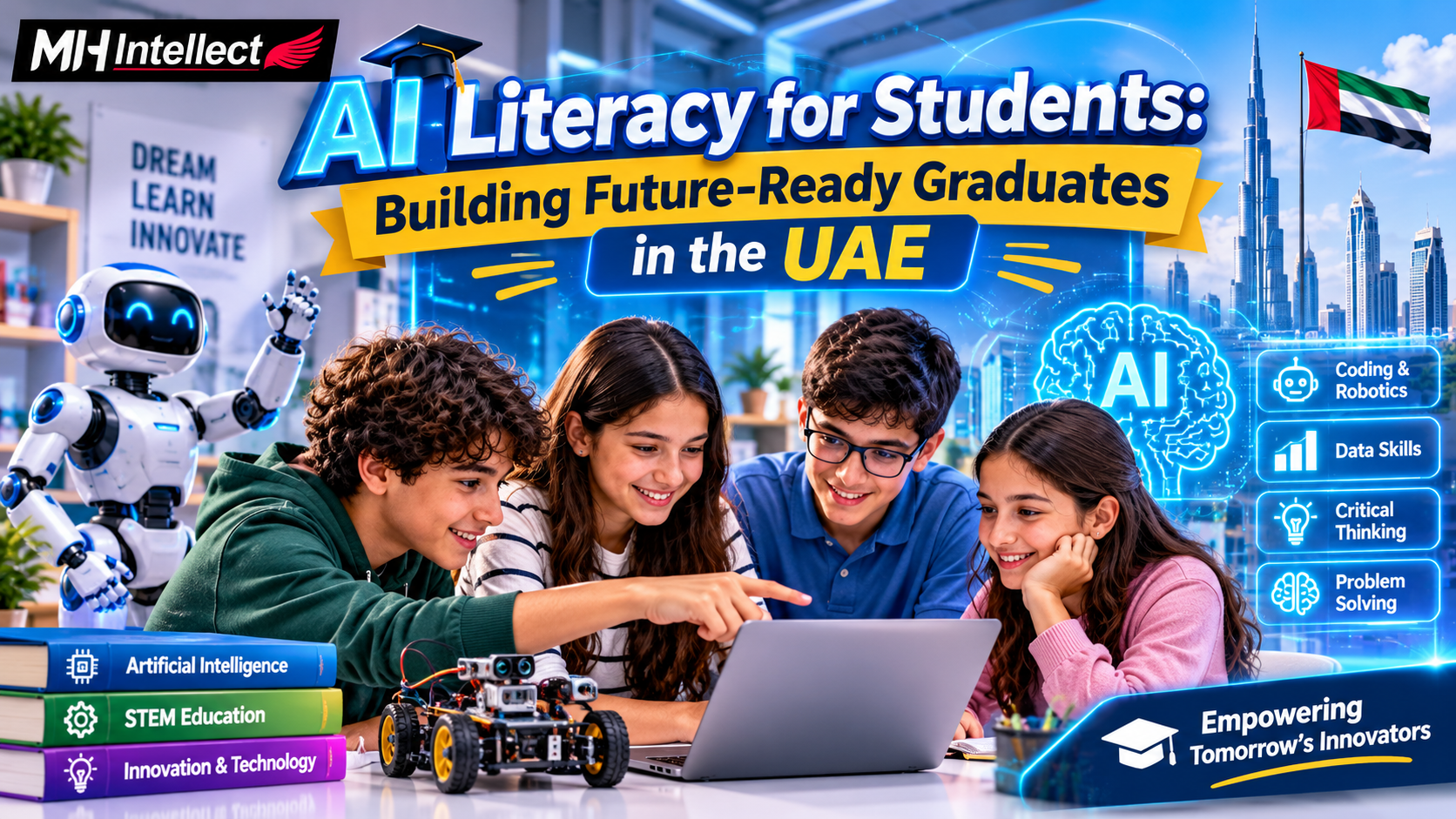
Artificial Intelligence (AI) is transforming education, workplaces, and industries worldwide. As technology continues to evolve, students need more than traditional academic knowledge to succeed in the future. Developing AI literacy helps young learners understand artificial intelligence, use digital tools responsibly, and build the skills needed for future careers. UAE schools are increasingly recognising the importance of introducing AI concepts through structured lessons and practical learning experiences.
Why AI Literacy Matters for Students
AI literacy involves understanding how artificial intelligence works, identifying its applications, evaluating AI-generated information, and using technology responsibly. It helps students become confident digital learners who can think critically about the information and tools they encounter.
By developing AI literacy in UAE schools, educators can prepare students to understand emerging technologies and their influence on everyday life. Learning about data, machine learning, automation, and intelligent systems encourages curiosity, creativity, and problem-solving abilities.
The Importance of AI Education for Schools
Introducing AI education for schools creates opportunities for students to explore artificial intelligence through age-appropriate activities. Younger learners can begin with visual coding, interactive games, and simple AI demonstrations. Older students can progress towards Python programming, machine learning, chatbot development, and data analysis.
Practical classroom activities make AI concepts easier to understand. Students can experiment with digital tools, explore how machines recognise patterns, and investigate how intelligent systems are used in healthcare, transportation, engineering, and communication.
Teachers also play an essential role in guiding students to understand data privacy, algorithmic bias, information accuracy, and ethical AI practices.
Connecting AI with STEM Education
Combining artificial intelligence with science, technology, engineering, and mathematics creates meaningful opportunities for interdisciplinary learning. AI-integrated STEM Education encourages students to apply their knowledge through coding challenges, robotics activities, engineering experiments, and technology-based projects.
For example, students can programme robots, build smart systems, analyse datasets, and develop simple applications. These activities strengthen computational thinking, collaboration, creativity, and analytical skills while connecting classroom learning with real-world challenges.
Developing Future-Ready Graduates in the UAE
The UAE continues to focus on innovation, digital transformation, and developing a skilled workforce. Preparing future-ready graduates in the UAE requires schools to provide learning experiences that combine academic knowledge with practical technology skills.
Students who understand artificial intelligence and emerging technologies can explore future opportunities in data science, robotics, software development, automation, engineering, and cybersecurity. Project-based learning, teamwork, and technology-based competitions can further strengthen their confidence and prepare them for evolving career opportunities.
Encouraging Practical Learning Through STEM Projects
Hands-on experiences are essential for developing a deeper understanding of technology. Through STEM Projects, students can turn creative ideas into practical solutions while exploring engineering, coding, robotics, and other emerging technologies.
MH Intellect supports schools in creating engaging STEM learning experiences that encourage innovation and technical understanding. As a STEM Implementation Partner, MH Intellect helps schools introduce structured, hands-on educational programmes that connect classroom learning with practical applications.
Educators can also explore the Student's Gallery to discover examples of student creativity, projects, and technology-based learning experiences.
Conclusion
AI literacy is becoming an essential part of modern education. By combining artificial intelligence with structured STEM programmes and practical classroom activities, schools can help students develop critical thinking, creativity, digital responsibility, and technical knowledge. Investing in AI literacy today can prepare UAE students to become confident graduates, innovative problem-solvers, and future technology leaders.