Remote Guarding Companies for Smarter Residential Access Management
Residential access is becoming more complex. Residents expect convenient entry, visitors arrive throughout the day, vendors work on different schedules, and delivery drivers may not be registered in advance. Property managers need systems that can organize this activity without turning every exception into a manual task. Remote Guarding Companies can support smarter residential access management by combining live communication with automated credentials, Visitor Management, and property-approved procedures.
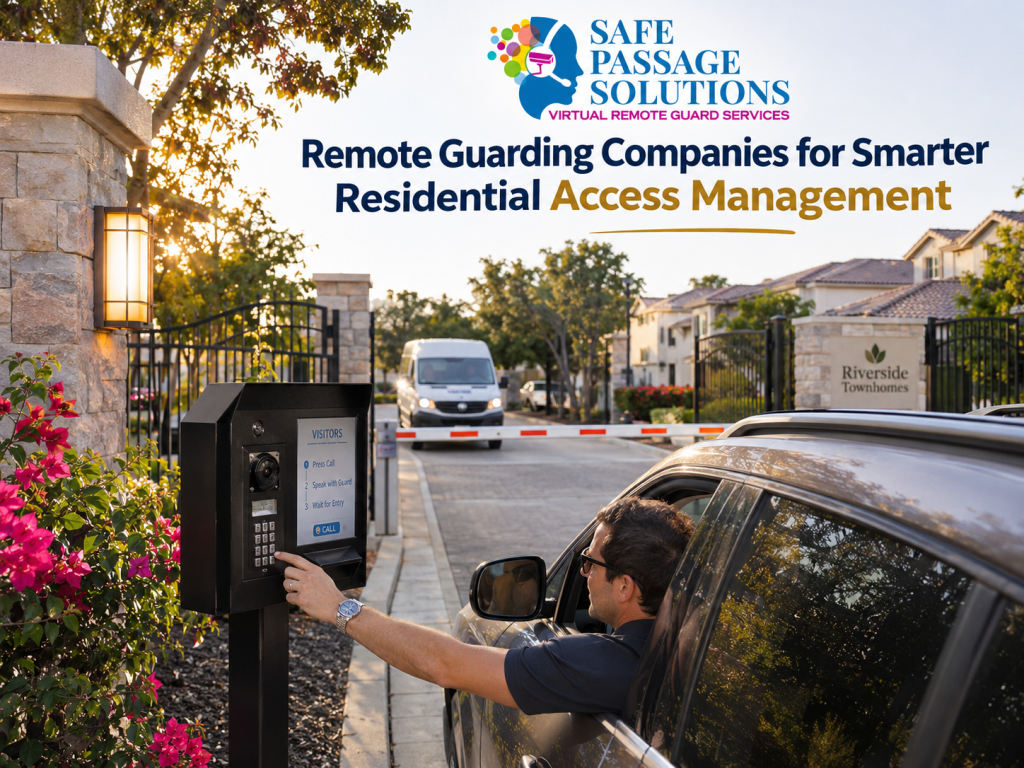
Smarter Access Means Using the Right Tool for the Right Task
A modern residential access system can divide work across several layers rather than using one process for every person who reaches the entrance. Routine resident access can remain automated, expected visitors can move through Visitor Management, live visitor exceptions can be supported through Remote Guarding, and unresolved authorization can move to escalation. This creates a more practical structure because each part of the access process is handled by the tool or procedure best suited to it.
Routine Resident Access Can Stay Automated
Residents should not need live assistance every time they enter their community. Depending on the property setup, routine resident access may use License Plate Recognition, RFID credentials, or other resident-access methods. Remote Guarding can then focus on situations automation cannot completely resolve, such as a resident driving a temporary vehicle, a credential issue, a visitor-information mismatch, an unlisted visitor, or an after-hours exception. This keeps live support focused where it adds the most value while routine resident entry remains efficient.
Visitor Management Can Make Temporary Access More Efficient
Visitor Management can organize expected guest information before arrival. Records may include the visitor's name, resident destination, arrival window, vendor company, authorized contact, and access instructions. ASIS International reports that many organizations are moving away from manual visitor processes toward more efficient electronic systems, while its access-control research also identifies visitor management as a critical component of effective access programs. ASIS Foundation — The Essentials of Access Control
For residential communities, the same principle can support smoother gate operations by making useful information available before the visitor arrives.
Remote Guarding Helps When Information Changes
No visitor-management database will perfectly predict every arrival. A guest may arrive in another vehicle, a visitor may come earlier than expected, a resident may forget to register someone, a contractor may send a replacement technician, a delivery driver may change, or the resident may not be immediately available.
Remote Guarding provides another step in the workflow. Depending on approved property procedures, attendants may review available information, communicate with the visitor, contact designated parties, and follow defined exception procedures. The purpose is not to bypass the access process but to give changing or unexpected situations a clear next step.
Smarter Access Does Not Mean Fewer Controls
Efficiency should not be confused with automatic access. A smarter process can still require appropriate authorization. When an expected visitor's details match the approved records, the request can proceed through the routine access procedure. Any differences in the information may require additional review. Should authorization remain unclear after verification, the request can be escalated according to the community's established procedures.
The goal is not to remove checks. It is to organize those checks so routine requests remain efficient while exceptions receive the appropriate level of review.
Resident-Managed Access Can Reduce Administrative Work
Residents often know their guest information better than property management. Depending on community policy, they may be able to manage expected personal guests, recurring visitors, visitor dates, and appropriate service-provider information. This can reduce routine property-management data entry while giving residents more control over information that directly relates to their own visitors.
Remote Guarding can then use the available information during the live gate interaction. This helps distribute access responsibilities more effectively without removing property-management oversight.
Current Records Are Still Essential
A sophisticated access system can still produce poor results if authorization data is outdated. Communities should review information when residents move, leases end, vehicles change, vendor permissions expire, temporary access ends, or authorized contacts change.
NIST's broader physical-access framework emphasizes verifying access authorization and controlling designated entry points. NIST SP 800-53 Rev. 5
The useful residential principle is simple: smarter technology still needs accurate data. Automated systems and live remote support both depend on current authorization information.
A Smarter Residential Access Model
Access Activity | Possible Process |
Routine resident entry | LPR, RFID, or another credential |
Expected personal visitor | Visitor Management |
Unlisted visitor | Remote Guarding exception process |
Approved recurring vendor | Vendor workflow |
Delivery requiring review | Delivery-access procedure |
After-hours request | Property-specific workflow |
Unresolved authorization | Escalation |
This allows access responsibilities to be distributed more efficiently instead of routing every interaction through property management.
Property Management Still Has an Important Role
Remote Guarding should not eliminate property-management oversight. Management may still need to control resident status, move-ins and move-outs, vendor policies, access expiration, community rules, escalation procedures, and serious access issues. The objective is to reduce repetitive transaction processing while preserving governance.
A well-designed system allows management to focus on higher-level responsibilities while automation, resident-managed tools, Visitor Management, and Remote Guarding handle appropriate routine activity.
Community Management Is Increasingly Using Automation
The Foundation for Community Association Research's 2026 management-company benchmarking report found that 44% of surveyed companies already use AI assistants or automation, while 79% are using or implementing AI and automation. Foundation for Community Association Research — Community Association Management Company Benchmarking
This reflects a broader industry trend toward using technology to reduce repetitive operational work. Remote Guarding can fit into that trend when it supports clearly defined access workflows rather than simply adding another system for property managers to monitor.
Frequently Asked Questions
What makes residential access management smarter?
Clear division of responsibilities, current information, automated routine access, and defined live exception procedures can all contribute to a more efficient access model.
Can Remote Guarding Companies work with automated credentials?
Yes. Remote Guarding can complement LPR, RFID, and other resident-access tools.
Can residents manage visitor information themselves?
Depending on community policy, residents may manage appropriate visitor information through Visitor Management.
Does Remote Guarding replace property management?
No. Property management retains responsibility for broader policy, authorization, resident status, and escalation.
Can Remote Guarding support unexpected visitors?
Yes. Remote attendants can follow the community's approved exception process.
Key Takeaways
Smarter residential access separates routine transactions from exceptions. Automated credentials can support resident entry, Visitor Management can organize expected arrivals, and Remote Guarding can support live exceptions. Resident-managed visitor information may reduce administrative workload, while current authorization remains essential and property management continues to oversee policy, resident status, and escalation. Automation and live support work best when each has a clearly defined role.
Final Thoughts
Smarter residential access is not about replacing people with automation. It is about using automation where the process is predictable and live support where additional communication is needed. Residents can use active credentials, expected guests can use Visitor Management, Remote Guarding can support changing or unexpected situations, and property managers can focus on policies and higher-level oversight.
That creates a more balanced residential access model.
Safe Passage Solutions can help communities explore how Virtual Remote Guard, Visitor Management, License Plate Recognition, and RFID Access Control may support smarter residential access management.