How Virtual Gate Guard Can Strengthen Visitor Verification at the Gate
Visitor verification becomes more difficult when the information at the gate is incomplete or unclear.
A vendor may claim to have an appointment. A guest may arrive outside the expected time. A contractor may send another technician.
Before access is considered, the property needs a way to understand whether the arrival matches what was expected.
This raises an important question:
How can Virtual Gate Guard strengthen visitor verification at the gate?
For gated communities, HOAs, apartment properties, and residential communities, stronger verification starts with useful information, clear authorization, and a consistent process.
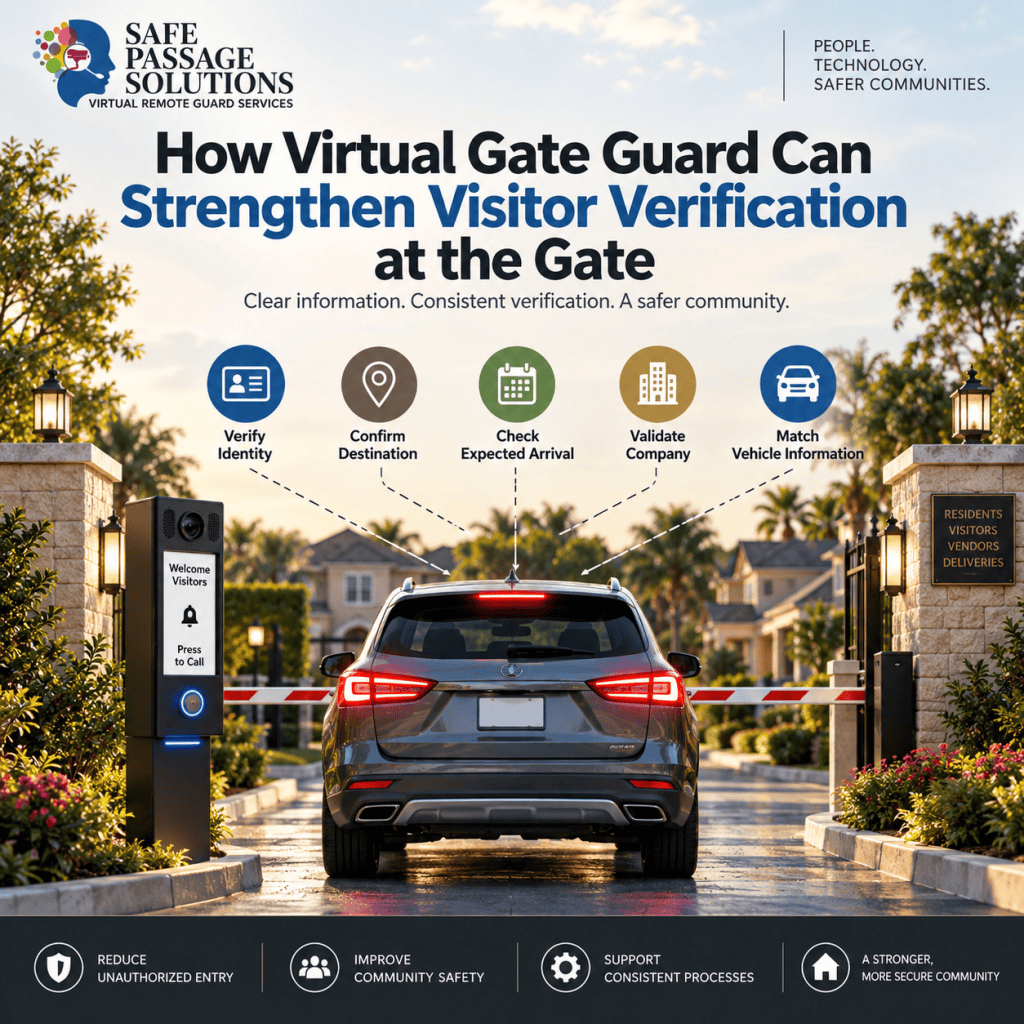
Visitor Verification Should Confirm More Than a Name
A visitor's name is only one part of the request.
Depending on the property, verification may also consider:
Destination
Purpose of visit
Expected arrival time
Resident or property contact
Company information
Existing authorization
Approved instructions
Vehicle information when relevant
Together, these details provide more context than identity alone.
The National Institute of Standards and Technology also treats identification and authorization as separate parts of physical access control.
For residential gate operations, the practical lesson is simple:
Knowing who someone is does not automatically mean the current visit is authorized.
Virtual Gate Guard Supports Live Verification
Virtual Gate Guard can provide live remote communication through compatible gate technology.
Depending on the property's procedures, Safe Passage Solutions remote attendants may:
Speak with the visitor
Review the expected record
Confirm the destination
Confirm the purpose of the visit
Follow approved verification steps
Contact an authorized person when required
Escalate the request if necessary
This adds a live verification step even when an onsite guard is not present.
ASIS International also emphasizes that visitor management combines technology with clear policies and procedures.
Compare the Arrival With What Was Expected
Visitor Management can help organize expected arrival information before the person reaches the gate.
When the visitor arrives, Virtual Gate Guard can compare the actual request with the available record.
Expected Information | What May Be Reviewed |
|---|---|
Visitor name | Does the arriving person match? |
Destination | Is the person going to the expected location? |
Arrival time | Is the visit within the expected period? |
Vendor company | Does the company match the record? |
Purpose | Does the stated reason match? |
Authorized contact | Is confirmation available if required? |
Not every field needs to apply to every visitor.
The property should define which information matters for each type of request.
Different Visitor Types May Need Different Verification
Consistent verification does not mean every visitor should follow exactly the same steps.
For example:
Visitor Type | Verification May Focus On |
|---|---|
Resident guest | Resident, destination, and expected visit |
Vendor | Company, work purpose, and authorized contact |
Contractor | Company, appointment, and service request |
Service technician | Company, scheduled service, and location |
Delivery driver | Recipient and destination |
The goal is consistency within each visitor category.
That is more practical than using one universal process for every arrival.
What If One Detail Does Not Match?
Not every mismatch means the request is invalid.
For example, a contractor may arrive in a different vehicle while the company, destination, and service request still match.
The first step is identifying what changed.
Depending on the property's procedures, the request may require:
Additional information
Confirmation from an authorized contact
Review of the expected record
Additional verification
Escalation
The Cybersecurity and Infrastructure Security Agency also emphasizes documented visitor-access and authorization procedures.
The broader principle is useful for gated communities: exceptions should follow a defined process instead of being handled differently each time.
Keep Verification Consistent
Verification becomes weaker when similar visitors receive different treatment.
For example, one vendor may be asked for confirmation while another is allowed through based on familiarity.
Communities can improve consistency by defining:
What information should be available
What must be confirmed
Who may authorize the request
What happens if information changes
When escalation is required
Virtual Gate Guard can then follow those established procedures during selected visitor interactions.
This reduces dependence on individual judgment and staff memory.
Use Only Information That Supports the Decision
Stronger verification does not mean collecting as much information as possible.
The property should determine what information is actually useful for the access process.
For example, a visitor's name, destination, authorized contact, and service purpose may be relevant.
Unrelated personal information may not be.
The goal is useful verification, not unnecessary data collection.
Signs Visitor Verification May Need Improvement
A community may want to review its process if it regularly experiences:
Missing visitor information
Informal approvals
Different verification requirements
Confusion about who can confirm a request
Long delays while information is reviewed
No clear response to mismatches
Heavy reliance on familiarity
Unclear escalation responsibilities
These issues may indicate that visitor verification needs more structure.
Visitor Verification Checklist
Verification Area | What Should Be Clear |
|---|---|
Identity | Who is requesting access? |
Destination | Where is the visitor going? |
Purpose | Why is the visit occurring? |
Expected record | Does the request match available information? |
Authorization | Is approval available when required? |
Visitor category | Which procedure applies? |
Mismatch | What additional review is needed? |
Escalation | Who makes the next decision? |
Frequently Asked Questions
Can Virtual Gate Guard verify visitors remotely?
Depending on the property's setup, remote attendants can communicate with visitors, review available information, and follow approved verification procedures.
Does identification mean authorization?
No. Confirming identity and confirming authorization are separate steps.
Can Visitor Management support verification?
Yes. Visitor Management can organize expected arrival details before the person reaches the gate.
Does every mismatch mean access should be denied?
Not necessarily. The request should follow the property's procedure for reviewing changed or incomplete information.
Can Virtual Gate Guard guarantee that unauthorized entry will never occur?
No. No access-control solution can guarantee that all unauthorized entry will be prevented.
Virtual Gate Guard can support stronger verification by providing live communication and following approved procedures.
Key Takeaways
Visitor verification should consider more than a name.
Identity and authorization are different.
Virtual Gate Guard can support live remote verification.
Visitor Management can provide an expected record for comparison.
Different visitor categories may require different procedures.
Mismatches should follow a defined review process.
Consistency matters more than collecting excessive information.
Final Thoughts
Stronger visitor verification starts with knowing what should be checked before an access request proceeds.
The goal is to compare the actual arrival with what was expected, confirm authorization when required, and follow a consistent process when something does not match.
Virtual Gate Guard can support that process through live communication and approved verification procedures.
For HOA boards and property managers, the process should answer three questions:
Who is requesting access?
Does the arrival match what the community expected?
Is the current visit authorized?
Safe Passage Solutions can help communities evaluate how Virtual Remote Guard, Visitor Management and License Plate Recognition may support visitor verification.