How Remote Guarding Companies Support Modern Community Security
Modern community security is increasingly built around multiple layers. A residential property may use resident credentials, cameras, Visitor Management, License Plate Recognition, RFID, intercom technology, and controlled entrances. Technology can support many routine access functions, but it does not eliminate the need for live communication. That is where Remote Guarding Companies can play an important role by supporting live interactions at controlled entrances and helping communities follow established access procedures when routine automation reaches an exception.
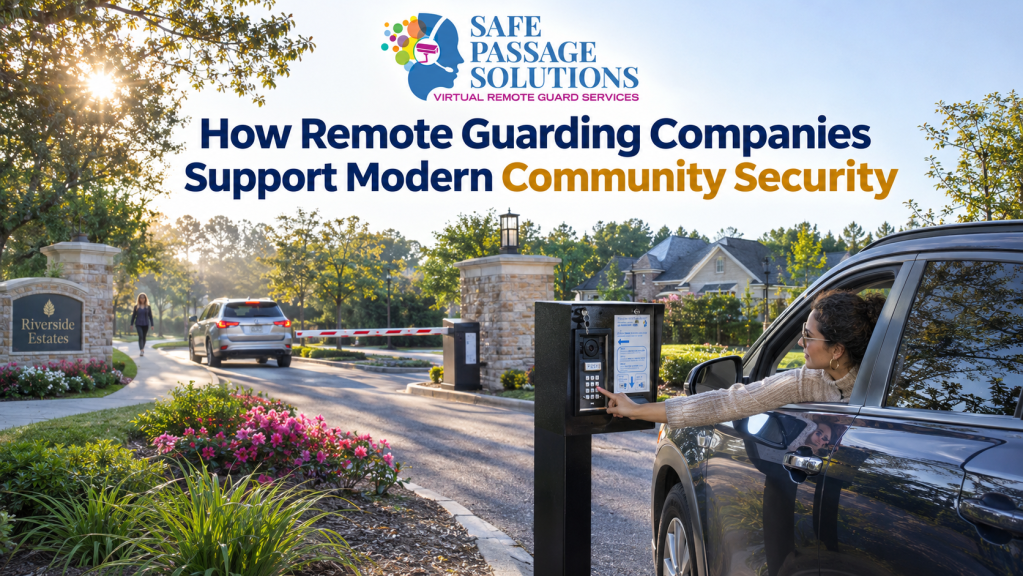
Modern Community Security Is Layered
No single security technology can reasonably address every situation. Different tools serve different purposes. RFID can support credentialed resident access, License Plate Recognition can provide vehicle context, Visitor Management can organize expected arrivals, cameras can provide visual information, Remote Guarding can provide live communication, and community procedures can define authorization and escalation.
The strongest model is not necessarily the one with the most technology. It is the one where each layer has a clearly defined role. ASIS International's access-control research emphasizes this combination of technology, policy, procedure, and human processes. It defines access-control systems as including both the technology and the procedures supporting them. ASIS International — Getting Visitor Management Right in Access Control
Remote Guarding Adds the Human Layer
Routine access can often be automated. An active resident credential may follow the normal entry process, while an expected visitor with matching information may follow the standard visitor workflow. Real community access, however, also includes situations such as a guest not being listed, a resident being unavailable, a vendor arriving outside the expected schedule, a contractor sending a replacement employee, a delivery requiring additional review, or vehicle information not matching.
A remote guarding company can provide live communication when those situations occur. Depending on the property's approved procedures, Safe Passage Solutions remote attendants may communicate with arriving visitors, confirm the stated destination and purpose, review available visitor information, contact designated parties, follow approved instructions, apply defined exception procedures, and escalate unresolved requests. The property establishes its authorization rules, while Remote Guarding supports those rules during the live interaction.
Visitor Management Remains Important
Remote Guarding works best when live attendants have useful information available. Visitor Management can help organize visitor names, destinations, arrival periods, vendor companies, authorized contacts, and property instructions. This gives the live interaction more context and can make routine visitor processing easier to manage.
ASIS research identifies visitor management as a critical part of modern access control and notes that organizations are increasingly trying to move away from inefficient manual visitor-management processes. When organized visitor information and live gate support work together, communities can create a more consistent access process.
Modern Security Should Not Depend on Assumptions
Remote Guarding should not be based on whether someone looks familiar or says the right thing. Knowing a resident's address does not automatically establish authorization. A familiar vendor does not necessarily have current permission. A recognized vehicle does not necessarily identify the current driver, and an unlisted visitor is not automatically unauthorized.
Instead, each situation should follow the property's approved procedure. That creates greater consistency and helps ensure that access decisions are based on current information rather than familiarity or assumptions.
Current Authorization Still Matters
Technology and remote attendants still depend on accurate records. Communities may need to update information when residents move, vehicles change, vendor agreements end, temporary permissions expire, contact information changes, or household access changes.
NIST's physical-access controls emphasize verifying authorization at defined access points and maintaining access controls around those entry points. NIST also identifies security guards as one possible layer of physical access control. Although NIST SP 800-53 Rev. 5 is not specifically designed for HOA communities, its broader guidance highlights an important principle: effective security depends on ensuring that access remains aligned with current authorization.
How Remote Guarding Fits into a Layered Strategy
Security Layer | Possible Role |
RFID | Routine credentialed resident entry |
LPR | Vehicle-based access context |
Visitor Management | Organize expected temporary access |
Cameras | Provide visual context |
Remote Guarding | Live interaction and exception handling |
Community procedures | Define authorization and escalation |
The systems should support one another rather than operate as disconnected tools. Automated credentials can handle predictable access, Visitor Management can organize temporary arrivals, cameras can provide useful context, and Remote Guarding can support situations that require live communication.
Remote Guarding Is Not Complete Property-Wide Security
Remote Guarding should also be understood within its proper scope. It can support controlled entrances and associated access workflows, but it is not automatically a replacement for property management, emergency services, law enforcement, internal patrol functions, perimeter planning, or broader incident-response procedures.
Clear expectations help communities understand what each security layer is designed to accomplish. Remote Guarding can strengthen the access process, but broader community security still depends on multiple systems, procedures, and responsibilities working together.
Community Security Should Reflect the Property
The Foundation for Community Association Research publishes research on technology, management, and operational risks affecting community associations. Its work reflects the increasing reliance of communities on digital tools, resident portals, software platforms, and emerging technologies. Foundation for Community Association Research — Technology and Data Security
That reinforces the importance of connecting technology to clearly defined community procedures. A community's access strategy should reflect its actual visitor activity, resident needs, vendor schedules, operating hours, property layout, and escalation requirements rather than simply adopting technology without a defined operational role.
Frequently Asked Questions
What do Remote Guarding Companies do?
Remote Guarding Companies provide live remote personnel who can support property-approved visitor and access procedures through compatible technology.
Can Remote Guarding replace automated access?
Not necessarily. It can complement RFID, LPR, Visitor Management, and other automated tools.
Can Remote Guarding support unlisted visitors?
Yes. Remote attendants can follow the property's approved exception workflow when a visitor is not listed or when available information does not match.
Do remote attendants independently decide who enters?
No. The property establishes its authorization and escalation rules.
Is Remote Guarding the same as complete community security?
No. It is one layer within a broader community-security strategy.
Key Takeaways
Modern community security works best as a layered system. Remote Guarding Companies can provide live communication at controlled entrances, Visitor Management can improve the information available during live interactions, and LPR and RFID can support predictable resident access. Remote Guarding should follow community-defined procedures, while current authorization remains essential to the overall process.
The strongest approach gives each technology and service a clear role instead of expecting one system to manage every security or access situation.
Final Thoughts
Modern community security does not rely on a single device or service. Instead, it depends on clearly defined roles working together. Automation can manage predictable access, while Visitor Management organizes temporary arrivals. Remote Guarding provides live support when situations require communication or verification. Meanwhile, established community procedures guide staff on how to respond when authorization remains unclear.
That layered approach gives communities a more practical way to manage access without expecting one security system to do everything.
Safe Passage Solutions can help communities evaluate how Virtual Remote Guard, Visitor Management, License Plate Recognition, and RFID Access Control may support a layered community-access strategy.