How Can Better Gate Access Help Reduce Unauthorized Entry with Virtual Gate Guard?
A gated entrance can help control access, but the gate itself is only one part of the process.
Visitors may arrive without a record. Vendors may show up outside the expected time. A driver may provide incomplete information. In other cases, the person requesting access may not have clear authorization.
This raises an important question:
How can better gate access help reduce unauthorized entry?
For gated communities, HOAs, apartment properties, and residential communities, a stronger process combines useful information, live communication, clear authorization, and defined procedures.
Virtual Gate Guard can support that process.
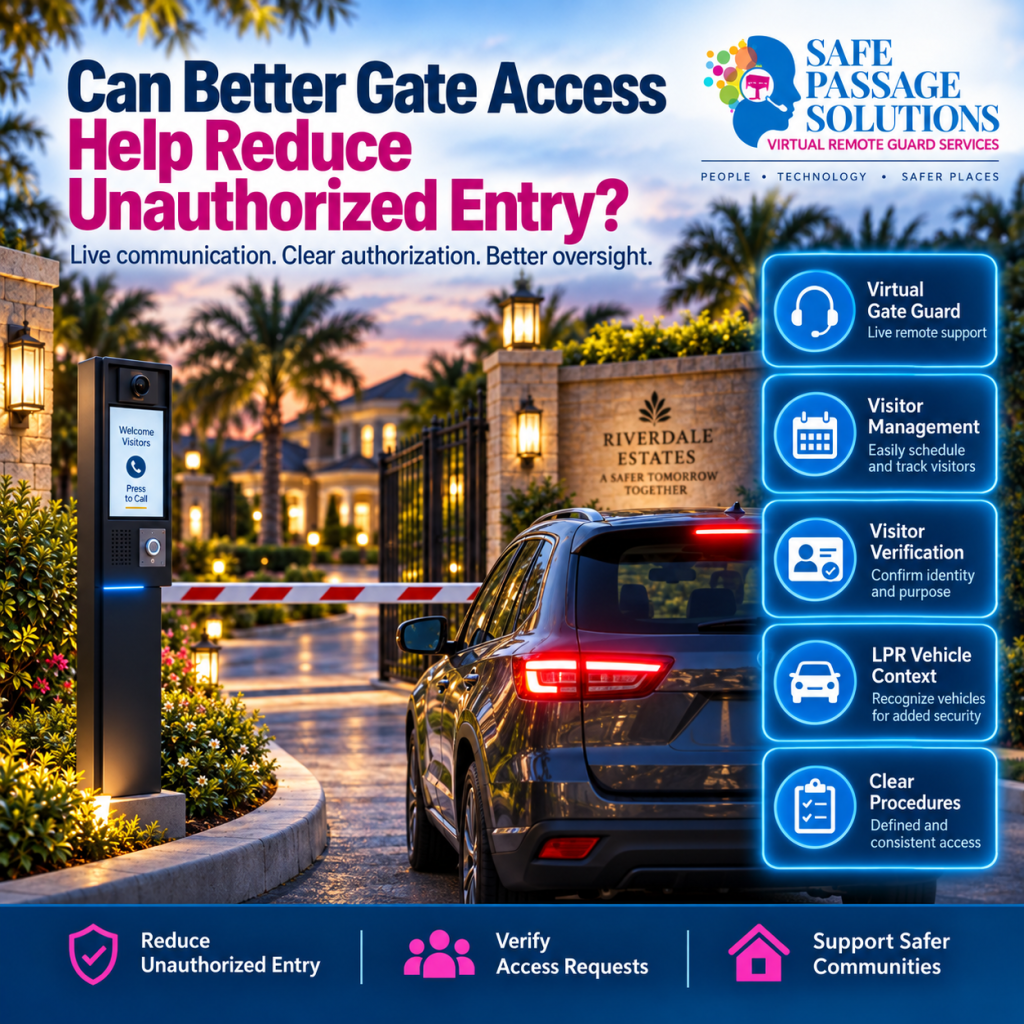
Better Gate Access Starts with Clear Authorization
Knowing who is at the gate is important.
However, identity alone does not confirm that the current visit is authorized.
The access process may need to determine:
Who is requesting access
Where the visitor is going
Why the person is there
Whether the visit was expected
Who authorized the visit
Whether that authorization is still valid
This distinction matters.
A familiar contractor may have visited the property many times before. That does not automatically mean the contractor is authorized for the current visit.
The National Institute of Standards and Technology also distinguishes physical access authorization from simple identification.
Although NIST guidance is written for organizational facilities, the broader principle is relevant to residential communities: recognition and authorization are not the same thing.
Virtual Gate Guard Provides Live Communication
Virtual Gate Guard can provide live remote support through compatible gate technology.
Depending on the property's approved procedures, Safe Passage Solutions remote attendants may:
Communicate with arriving visitors
Review available information
Confirm the stated purpose
Follow approved instructions
Contact authorized parties when required
Support selected access requests
Escalate unresolved requests
This gives the property a live point of interaction without requiring someone to remain physically stationed at the entrance.
The role of Virtual Gate Guard is not simply to open or close the gate.
It is to support the property's established access process through live communication.
Visitor Management Can Provide Expected Arrival Information
Visitor Management can help organize information before a guest, vendor, contractor, or service provider reaches the gate.
Depending on the property, records may include:
Visitor name
Destination
Expected arrival time
Resident or property contact
Company information
Purpose of visit
Vehicle information
Approved instructions
When the visitor arrives, the access team can compare the actual request with the available record.
That can help identify requests that need additional review.
ASIS International also notes that visitor management can involve different types of guests, vendors, contractors, and temporary personnel.
That supports a simple principle: better gate access depends on both information and clear procedures.
Changed Information Should Trigger a Defined Review
Not every arrival will match the original record.
For example:
A different visitor may arrive
The vehicle may have changed
A vendor may send another employee
The visitor may arrive late
Required information may be missing
The authorized contact may be unavailable
A mismatch does not automatically mean unauthorized entry is being attempted.
However, it may require additional review.
The property should define:
What information must be checked
Who may confirm the changed request
Whether additional verification is required
Who serves as a backup contact
When escalation is necessary
This gives the gate team a defined response instead of forcing personnel to improvise.
What Happens When Authorization Cannot Be Confirmed?
Some requests may remain unresolved even after additional review.
For example:
No matching visitor record exists
The resident cannot be reached
The vendor company does not match
Required information is unavailable
Multiple details differ from the record
The community should already know what happens next.
Depending on the property, the response may include:
Additional verification
Contacting a backup authorized person
Escalation
Delay
Another approved response
Virtual Gate Guard can follow that established process rather than making an independent authorization decision.
LPR Can Add Vehicle Context
License Plate Recognition can provide license plate information at designated access points.
When vehicle information is relevant, LPR may provide another point of comparison.
For example, the access team may review:
The arriving license plate
Expected vehicle information
Available visitor or vendor records
However, LPR should not serve as the sole basis for authorization.
Vehicle information is one part of the larger access request.
Stronger Gate Access Uses Multiple Points of Context
A stronger process does not depend on one piece of information.
Instead, the gate team may consider several factors together:
Identity → destination → purpose → expected record → authorization → vehicle context → property procedure
The exact requirements should depend on the property and the type of visitor.
For example, a resident guest may follow a different process from a contractor arriving for scheduled maintenance.
The goal is not to make every visitor follow the same steps.
It is to make sure each visitor category has clear requirements.
Why This Matters for HOAs and Gated Communities
Gate-access procedures should be established at the community level.
The Community Associations Institute discusses access-control planning, vehicular access, automated gates, and visitor-entry procedures in community-security guidance.
For HOA boards and property managers, the practical takeaway is simple:
Gate decisions should follow approved community procedures rather than depend only on individual judgment at the entrance.
Signs Your Gate Access Process May Need Review
A community may benefit from reviewing its procedures if it regularly experiences:
Unknown visitors at the entrance
Missing visitor records
Different responses to similar requests
Unclear authorization rules
Vendors arriving outside approved periods
Frequent calls to management
Heavy reliance on staff familiarity
No clear escalation process
These issues do not prove unauthorized entry is occurring.
However, they may reveal areas where the gate-access process could be stronger.
Gate Access Review Checklist
Access Area | What to Review |
|---|---|
Visitor information | Is useful arrival information available? |
Authorization | Is approval clearly defined? |
Live communication | Can Virtual Gate Guard assist? |
Expected visitors | Are Visitor Management records available? |
Vehicle context | Is LPR used appropriately? |
Changed information | Is additional review defined? |
Backup contacts | Is another authorized person available? |
Escalation | Is there a clear next step? |
Frequently Asked Questions
Can Virtual Gate Guard prevent all unauthorized entry?
No. No access-control solution can guarantee that unauthorized entry will never occur.
Virtual Gate Guard can support a stronger process through live communication and approved authorization procedures.
How can Visitor Management support better gate access?
Visitor Management can organize expected arrival information so the access team has more context when reviewing a request.
Does recognizing a visitor mean the person is authorized?
No. Recognition and authorization are different. The property should confirm whatever information is required for the current visit.
Can LPR make the access decision?
No. LPR can provide vehicle context, but it should not independently determine authorization.
What happens if a visitor cannot be confirmed?
The request should follow the property's established verification or escalation procedure.
Key Takeaways
Better gate access begins with clear authorization.
Identity and authorization are different.
Virtual Gate Guard can provide live remote communication.
Visitor Management can provide expected arrival context.
Changed information should trigger a defined review.
LPR can add vehicle context but should not determine authorization by itself.
Unresolved requests should follow established escalation procedures.
Final Thoughts
Reducing unauthorized entry is not about relying on one technology.
A stronger gate-access process combines useful visitor information, live communication, clear authorization, vehicle context when appropriate, and defined escalation procedures.
Virtual Gate Guard can support that process by providing a live remote point of interaction while following the community's approved access rules.
For HOA boards and property managers, the gate should be able to answer three important questions:
Who is requesting access? Why are they requesting access? Is the current request authorized?
Safe Passage Solutions can help communities evaluate how Virtual Remote Guard, Visitor Management, and License Plate Recognition may support a stronger gate-access strategy.