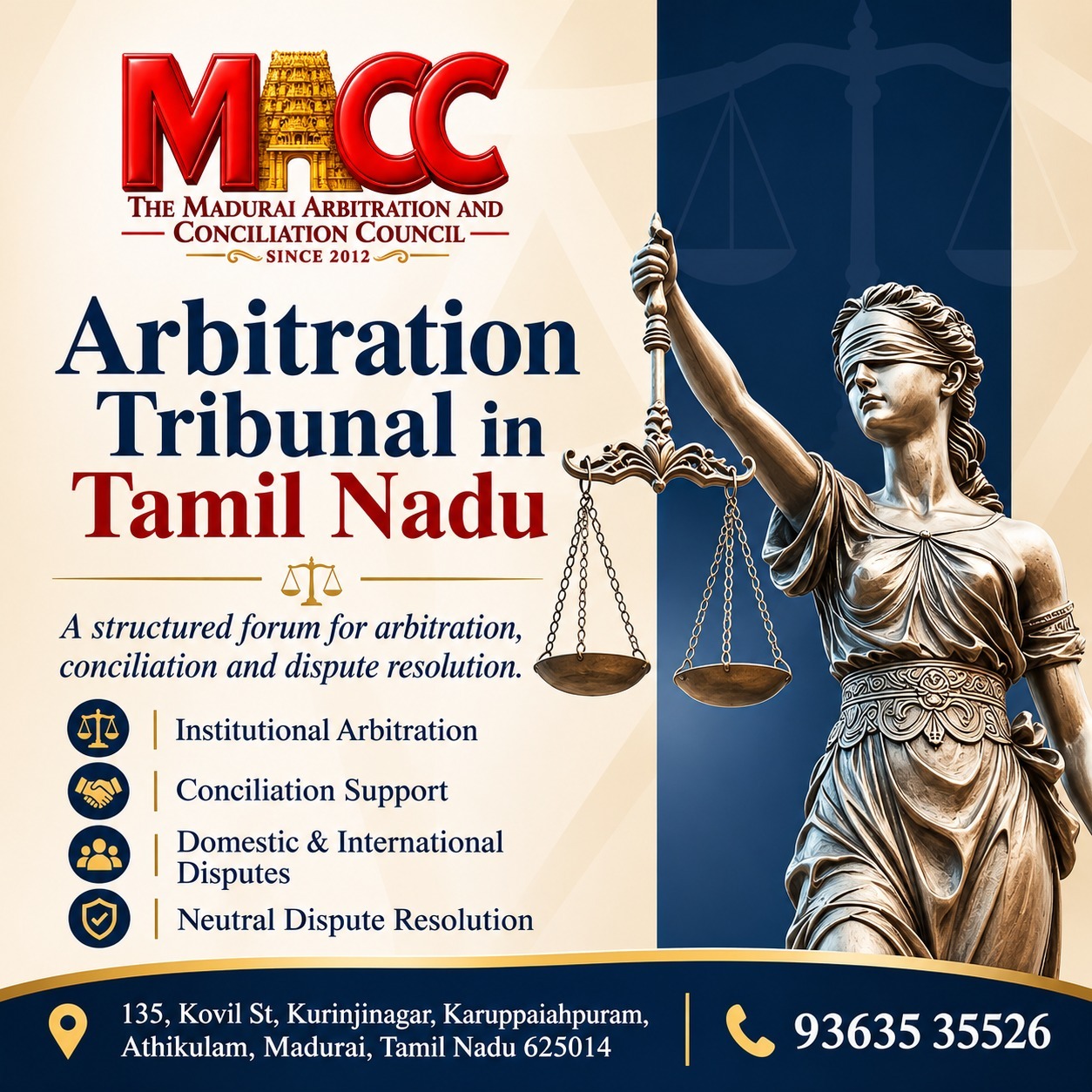
Arbitration Tribunal in Tamil Nadu: A Complete Guide to Fast, Fair Dispute Resolution
Litigation in Indian courts can take years to resolve even a straightforward commercial disagreement. For businesses, property owners, and individuals in Tamil Nadu who need a quicker, less adversarial route to justice, an arbitration tribunal in Tamil Nadu offers a practical alternative. One such institution is the Madurai Arbitration and Conciliation Council (MACC), which has been resolving disputes in the region since 2012.
This guide explains what an arbitration tribunal does, how the process works in Tamil Nadu, and why institutions like MACC have become a preferred choice for individuals, advocates, and corporates alike.
What Is an Arbitration Tribunal?
An arbitration tribunal is a private, legally recognized forum where parties to a dispute agree to have their disagreement decided by one or more neutral arbitrators instead of a court judge. In India, arbitration is governed by the Arbitration and Conciliation Act, 1996, which gives arbitral awards the same binding, enforceable status as a court decree.
Arbitration tribunals typically handle:
Commercial and contractual disputes
Property and real estate disagreements
Banking and finance recovery matters
Employment and partnership disputes
Construction and infrastructure claims
The appeal is simple: arbitration is faster, more confidential, and usually far less expensive than years of court litigation.
MACC: A Leading Arbitration Tribunal in Tamil Nadu
Based in Madurai, the Madurai Arbitration and Conciliation Council is an institutional arbitration body offering domestic and international arbitration, mediation, conciliation, and Online Dispute Resolution (ODR) services across Tamil Nadu. It positions itself as a neutral, rules-based platform where disputing parties — whether individuals, advocates, or companies — can reach enforceable settlements without the delays typical of civil courts.
MACC describes its mission as bringing clarity and resolution to complex legal conflicts while empowering parties to reach agreeable outcomes efficiently.
Key Services Offered
Institutions like MACC generally offer a full spectrum of alternative dispute resolution (ADR) services, including:
Institutional (Domestic) Arbitration — formal, binding proceedings for disputes within India
International Arbitration — resolving cross-border commercial disputes
Mediation & Conciliation — facilitated negotiation aimed at a mutually agreeable settlement
Online Dispute Resolution (ODR) — digital-first case filing and hearings for geographically separated parties
Facility Booking — physical arbitration halls equipped for formal proceedings
Empanelment — a panel of experienced arbitrators, including retired judges and senior advocates
Those wanting to explore the full service list can visit the MACC service spectrum directly.
How the Arbitration Process Works
While procedures vary by case and institution, a typical arbitration tribunal process in Tamil Nadu follows these broad steps:
Arbitration Agreement/Clause — Parties must have an arbitration clause in their contract, or agree separately to arbitrate.
Filing a Request — The claimant submits a request for arbitration with relevant documents and fees.
Appointment of Arbitrator(s) — A neutral arbitrator or panel is appointed, often from the institution’s empanelled list.
Preliminary Hearing — Procedural timelines, document exchange, and hearing schedules are fixed.
Hearings & Evidence — Both parties present arguments, documents, and witnesses.
Award — The arbitrator issues a binding, written arbitral award, enforceable like a court decree.
Institutions typically publish their own procedural rules and a transparent cost structure so parties know fees upfront before initiating proceedings.
Why Choose Arbitration Over Litigation?
Speed — Resolution in months rather than years
Confidentiality — Proceedings and outcomes stay private between parties
Cost savings — Lower overall legal expense compared to prolonged litigation
Expert decision-makers — Panels often include retired judges and senior advocates with subject-matter expertise
Enforceability — Arbitral awards carry the same legal weight as a court judgment
Why MACC Stands Out Among Tamil Nadu’s Arbitration Institutions
A few factors make MACC a notable arbitration tribunal in Tamil Nadu:
ISO Certification — Certified under ISO 9001:2015 (Quality Management) and ISO 37001:2025 (Anti-Bribery Management), signaling adherence to global quality and integrity standards
Experienced Panel — Arbitrators drawn from retired judiciary and senior legal practitioners
Modern Infrastructure — Both physical arbitration halls and a digital ODR portal for remote hearings
Track Record — Operating since 2012, with empanelment and accreditation from several corporate and financial institutions
Parties interested in initiating a case or learning about empanelment can reach out through MACC’s help desk.
Frequently Asked Questions
1. What is the difference between arbitration and mediation?
Arbitration results in a binding decision made by a neutral arbitrator after hearing both sides, similar to a court judgment. Mediation, by contrast, is a facilitated negotiation where a neutral mediator helps parties reach their own voluntary agreement — it isn’t binding unless both sides sign off on the settlement.
2. Is an arbitral award legally enforceable in Tamil Nadu?
Yes. Under the Arbitration and Conciliation Act, 1996, an arbitral award has the same legal force as a civil court decree and can be enforced through the appropriate courts if a party fails to comply voluntarily.
3. How long does arbitration typically take compared to court litigation?
Arbitration proceedings generally resolve in a matter of months, depending on case complexity, compared to court litigation, which can stretch over several years due to backlog and procedural delays.
4. Can international or out-of-state parties use a Tamil Nadu-based arbitration tribunal?
Yes. Many institutions, including those offering Online Dispute Resolution (ODR), allow parties from different states or countries to participate in hearings remotely without needing to travel to Tamil Nadu.
5. What documents are needed to start an arbitration case?
Typically, a claimant needs the underlying contract or arbitration agreement/clause, a statement of claim outlining the dispute, supporting evidence or correspondence, and payment of the institution’s filing fee as per its published cost structure.
Conclusion
For individuals, businesses, and advocates in Tamil Nadu seeking a faster and more confidential path to resolving disputes, an institutional arbitration tribunal is often the smarter route compared to prolonged court litigation. Institutions such as MACC combine experienced arbitrators, ISO-certified processes, and modern digital infrastructure to make dispute resolution more accessible. To learn more about filing a case, empanelment, or available services, visit www.maccmadurai.org.