QIMMA قِمّة ⛰: A Quality-First Arabic LLM Leaderboard
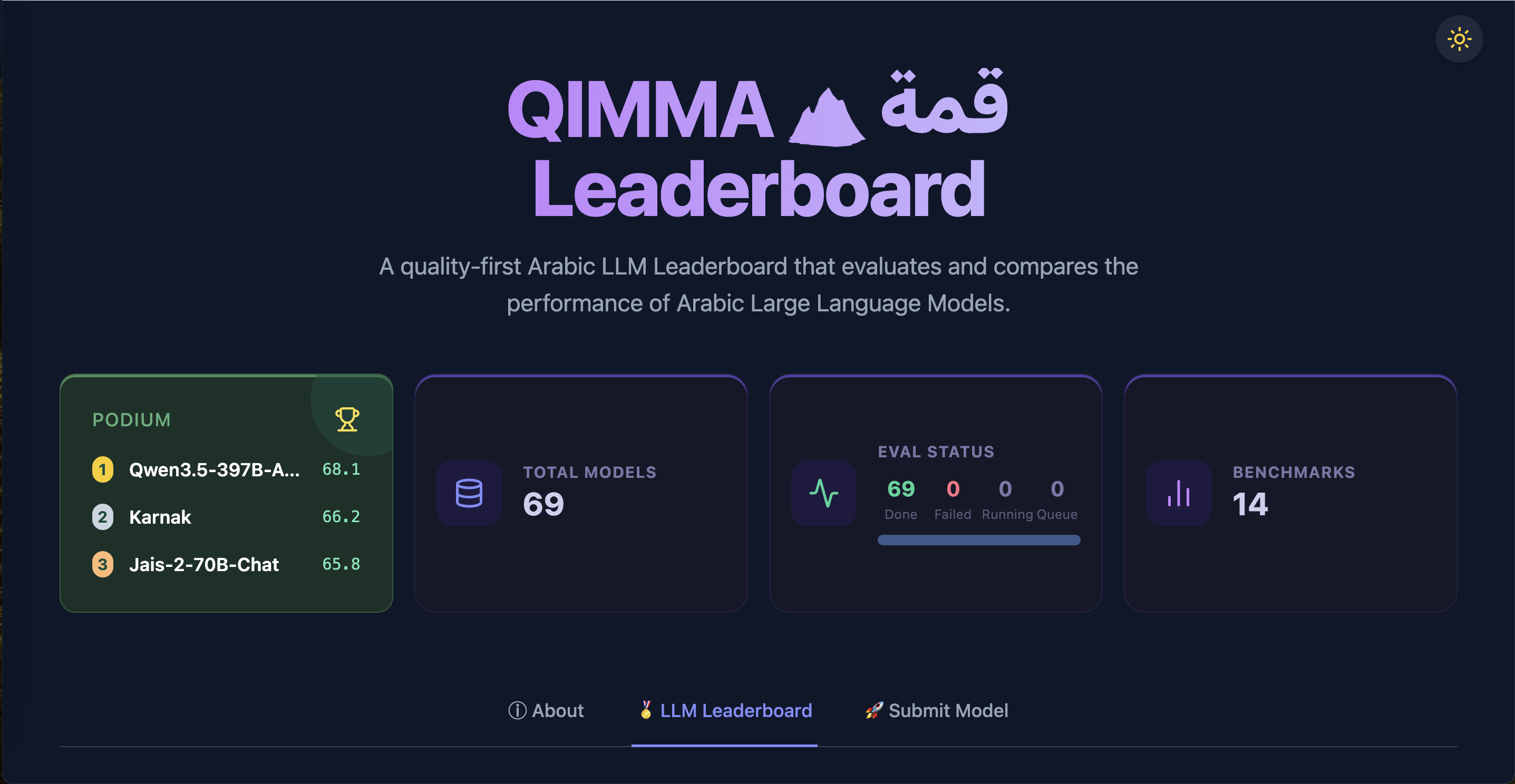
QIMMA validates benchmarks before evaluating models, ensuring reported scores reflect genuine Arabic language capability in LLMs.
If you've been tracking Arabic LLM evaluation, you've probably noticed a growing tension: the number of benchmarks and leaderboards is expanding rapidly, but are we actually measuring what we think we're measuring?
We built QIMMA قمّة (Arabic for "summit"), to answer that question systematically. Instead of aggregating existing Arabic benchmarks as-is and running models on them, we applied a rigorous quality validation pipeline before any evaluation took place. What we found was sobering: even widely-used, well-regarded Arabic benchmarks contain systematic quality issues that can quietly corrupt evaluation results.
This post walks through what QIMMA is, how we built it, what problems we found, and what the model rankings look like once you clean things up.
🔍 The Problem: Arabic NLP Evaluation Is Fragmented and Unvalidated
Arabic is spoken by over 400 million people across diverse dialects and cultural contexts, yet the Arabic NLP evaluation landscape remains fragmented. A few key pain points have motivated this work:
Translation issues. Many Arabic benchmarks are translations from English. This introduces distributional shifts. Questions that feel natural in English become awkward or culturally misaligned in Arabic, making benchmark data less representative of how Arabic is naturally used.
Absent quality validation. Even native Arabic benchmarks are often released without rigorous quality checks. Annotation inconsistencies, incorrect gold answers, encoding errors, and cultural bias in ground-truth labels have all been documented in established resources.
Reproducibility gaps. Evaluation scripts and per-sample outputs are rarely released publicly, making it hard to audit results or build on prior work.
Coverage fragmentation. Existing leaderboards cover isolated tasks and narrow domains, making holistic model assessment difficult.
To illustrate where QIMMA sits relative to existing platforms:
Leaderboard
Open Source
Native Arabic
Quality Validation
Coding Eval
Public Outputs
OALL v1
✅
Mixed
❌
❌
✅
OALL v2
✅
Mostly
❌
❌
✅
BALSAM
Partial
50%
❌
❌
❌
AraGen
✅
100%
✅
❌
❌
SILMA ABL
✅
100%
✅
❌
✅
ILMAAM
Partial
100%
✅
❌
❌
HELM Arabic
✅
Mixed
❌
❌
✅
⛰ QIMMA
✅
99%
✅
✅
✅
QIMMA is the only platform combining all five properties: open source, predominantly native Arabic content, systematic quality validation, code evaluation, and public per-sample inference outputs.
⛰ What's in QIMMA?
QIMMA consolidates 109 subsets from 14 source benchmarks into a unified evaluation suite of over 52,000 samples, spanning 7 domains:
Domain
Benchmarks
Task Types
Cultural
AraDiCE-Culture, ArabCulture, PalmX
MCQ
STEM
ArabicMMLU, GAT, 3LM STEM
MCQ
Legal
ArabLegalQA, MizanQA
MCQ, QA
Medical
MedArabiQ, MedAraBench
MCQ, QA
Safety
AraTrust
MCQ
Poetry & Literature
FannOrFlop
QA
Coding
3LM HumanEval+, 3LM MBPP+
Code
A few things stand out about this design:
99% native Arabic content. The only exception is code evaluation, which is inherently language-agnostic.
First Arabic leaderboard with code evaluation. QIMMA integrates Arabic-adapted versions of HumanEval+ and MBPP+, making it possible to assess coding capability with Arabic-language problem statements.
Diversity in Domains and Tasks. QIMMA evaluates real-world competency areas including education, governance, healthcare, creative expression, and software development.
🔬 The Quality Validation Pipeline
This is the methodological heart of QIMMA. Before running a single model, we applied a multi-stage validation pipeline to every sample in every benchmark.
Stage 1: Multi-Model Automated Assessment
Each sample was independently evaluated by two state-of-the-art LLMs:
Qwen3-235B-A22B-Instruct
DeepSeek-V3-671B
We chose two models with strong Arabic capability but different training data compositions, so that their combined judgment is more robust than either alone.
Each model scores a sample against a 10-point rubric, with binary scores (0 or 1) per criterion:
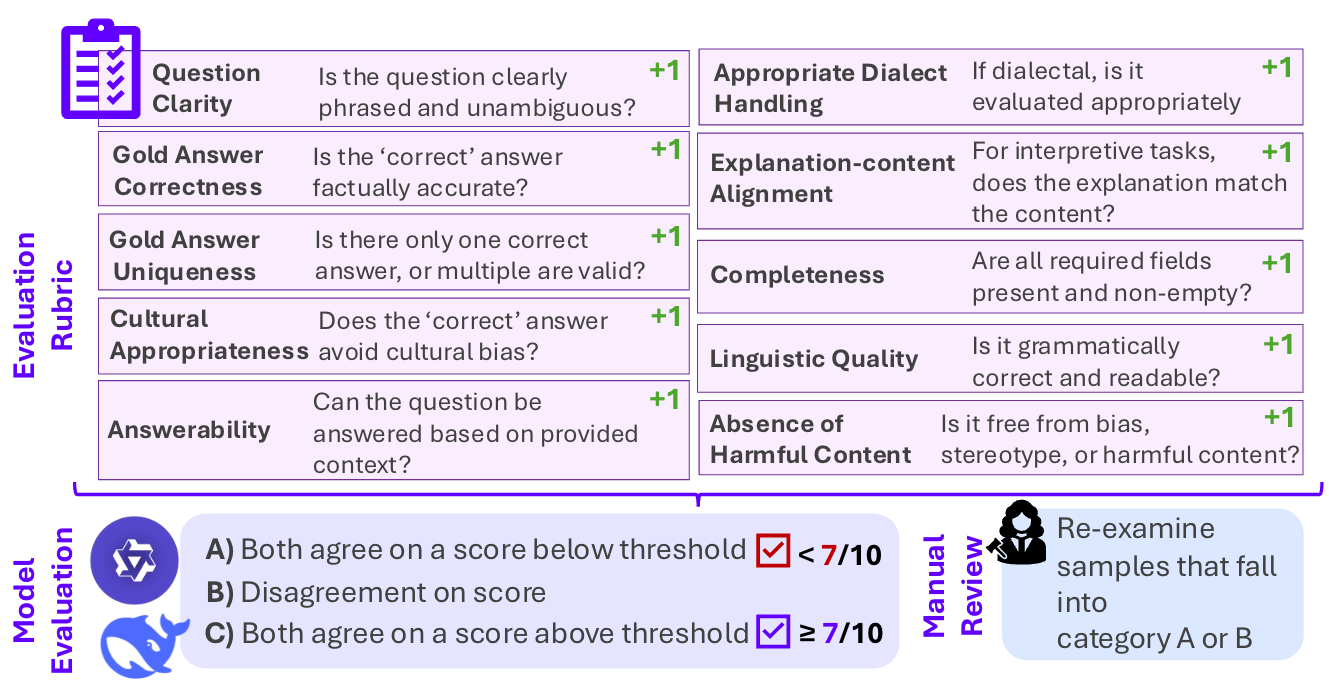
A sample is eliminated if either model scores it below 7/10. Samples where both models agree on elimination are dropped immediately. However, where only one model flags a sample, it proceeds to human review in Stage 2.
Stage 2: Human Annotation and Review
Flagged samples are reviewed by native Arabic speakers with cultural and dialectal familiarity. Human annotators make final calls on:
Cultural context and regional variation
Dialectal nuance
Subjective interpretation
Subtle quality issues automated assessment may miss
For culturally sensitive content, multiple perspectives are considered, since "correctness" can genuinely vary across Arab regions.
⚠️ What We Found: Systematic Quality Problems
The pipeline revealed recurring quality issues across benchmarks; not isolated errors, but systematic patterns reflecting gaps in how benchmarks were originally constructed.
By the Numbers
Benchmark
Total Samples
Discarded
Discard Rate
ArabicMMLU
14,163
436
3.1%
MizanQA
1,769
41
2.3%
PalmX
3,001
25
0.8%
MedAraBench
4,960
33
0.7%
FannOrFlop
6,984
43
0.6%
ArabCulture
3,482
7
0.2%
MedArabiQ
499
1
0.2%
GAT
13,986
1
~0.0%
3LM STEM
2,609
1
~0.0%
AraDiCE-Culture
180
0
0.0%
ArabLegalQA
79
0
0.0%
AraTrust
522
0
0.0%
Taxonomy of Issues Found
💻 Code Benchmark: A Different Kind of Quality Work
Code benchmarks required a different intervention. Rather than discarding samples, we refined the Arabic problem statements in 3LM's Arabic adaptations of HumanEval+ and MBPP+, leaving task identifiers, reference solutions, and test suites completely unchanged.
The modification rates were striking:
Benchmark
Total Prompts
Modified
Unchanged
Modification Rate
3LM HumanEval+
164
145
19
88%
3LM MBPP+
378
308
70
81%
Modifications fell into five categories:
Linguistic refinement : normalizing toward natural Modern Standard Arabic and consistent imperative style
Clarity improvements : fixing ambiguous instructions and unclear constraints
Consistency normalization : standardizing mathematical terminology, punctuation, and example formatting
Structural corrections : fixing broken triple-quoted strings, indentation errors, corrupted text fragments
Semantic refinements : clarifying whether ranges are inclusive/exclusive, preserving task intent
⚙️ Evaluation Setup
Evaluation Framework
QIMMA uses LightEval, EvalPlus and FannOrFlop as its evaluation framework, chosen for consistency, multilingual community adoption, and reproducibility.
Metrics by Task Type
Task Type
Metric
Benchmarks
MCQ
Normalized Log-Likelihood Accuracy
AraDiCE-Culture, ArabicMMLU, ArabCulture, PalmX, 3LM STEM, MedArabiQ, GAT, MedAraBench, AraTrust
Multi-select MCQ
Probability Mass on Gold Choices
MizanQA
Generative QA
F1 BERTScore (AraBERT v02)
MedArabiQ, ArabLegalQA, FannOrFlop
Code
Pass@1
3LM HumanEval+, 3LM MBPP+
Prompt Templates
QIMMA standardizes prompting by question format, with six template types:
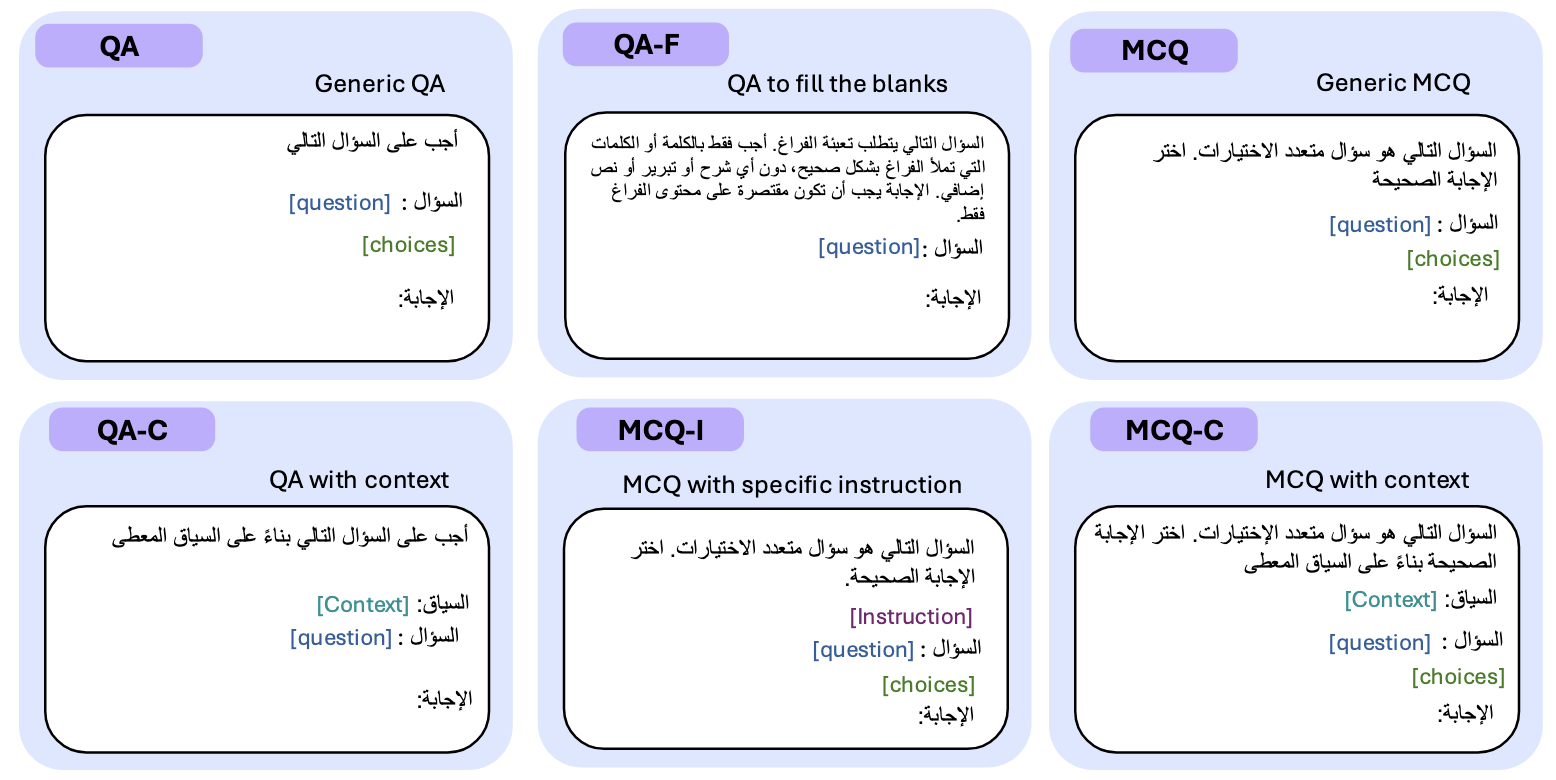
MCQ: generic multiple choice · MCQ-C: multiple choice with context passage · MCQ-I: multiple choice with specific instructions (GAT analogy/completion) · QA: generic open-ended QA · QA-C: QA with context · QA-F: fill-in-the-blank QA
All prompts are in Arabic. For MizanQA and ArabCulture, benchmark-specific system prompts from the original papers are preserved.
🏆 Leaderboard Results
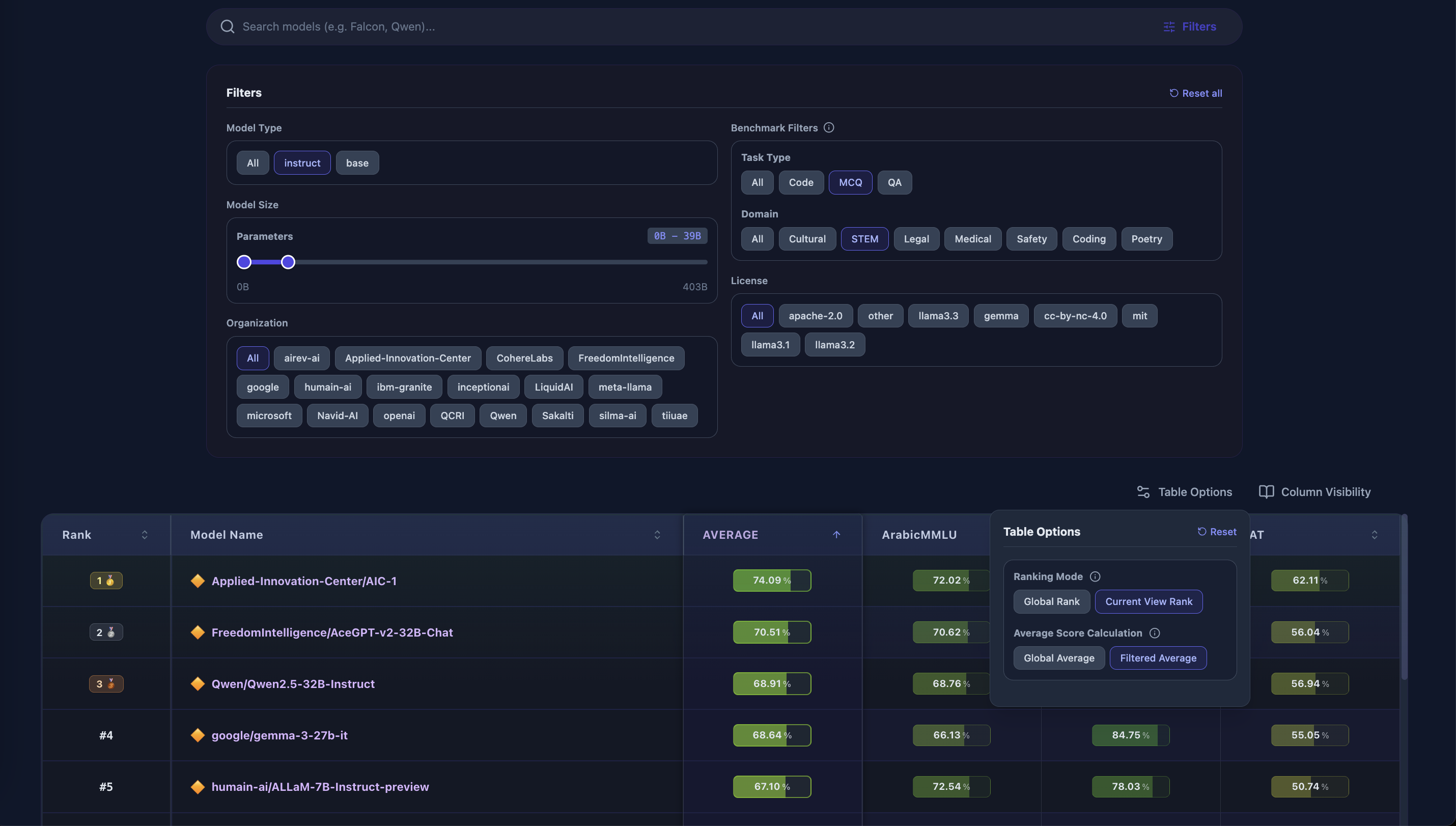
Results as of April 2026; covering top 10 evaluated models. Visit the live leaderboard for current rankings.
Rank
Model
AVERAGE
AraDiCE-Culture
ArabicMMLU
ArabCulture
PALMX
3LM STEM
AraTrust
MizanQA
MedArabiQ
ArabLegalQA
GAT
MedAraBench
HumanEval+
MBPP+
FannOrFlop
🥇 1
Qwen/Qwen3.5-397B-A17B-FP8
68.06
82.78
77.54
61.75
83.91
88.67
90.04
73.36
47.30
54.94
55.89
47.97
67.68
76.72
44.33
🥈 2
Applied-Innovation-Center/Karnak
66.20
73.33
80.94
53.49
81.40
93.10
89.08
55.92
55.78
71.58
61.06
54.19
33.54
64.55
58.91
🥉 3
inceptionai/Jais-2-70B-Chat
65.81
78.89
81.29
83.24
83.73
87.96
90.23
71.78
52.79
69.60
51.67
50.89
19.51
43.65
56.13
#4
Qwen/Qwen2.5-72B-Instruct
65.75
77.22
73.78
63.83
77.77
87.55
88.51
63.49
50.06
70.74
55.90
44.19
37.20
72.75
57.51
#5
Applied-Innovation-Center/AIC-1
65.37
73.33
72.02
77.52
76.11
88.13
90.61
56.36
53.75
68.96
62.11
50.78
28.05
69.58
47.83
#6
Qwen/Qwen3.5-122B-A10B
64.84
74.44
73.17
37.78
81.46
86.18
86.97
64.01
47.04
55.11
50.90
52.49
65.24
72.43
60.54
#7
Sakalti/Ultiima-72B
64.49
78.33
72.28
68.79
76.75
83.70
89.08
60.44
44.58
69.12
46.91
42.25
39.02
74.07
57.56
#8
meta-llama/Llama-3.3-70B-Instruct
63.96
77.22
71.57
78.05
77.95
88.28
85.63
67.44
56.25
64.00
51.13
54.86
27.44
71.16
24.43
#9
Qwen/Qwen2.5-32B-Instruct
63.26
70.56
68.76
75.80
72.07
81.03
85.82
53.78
48.08
69.27
56.94
36.51
34.15
72.75
93.10
#10
FreedomIntelligence/AceGPT-v2-32B-Chat
61.14
76.67
70.62
79.79
74.46
84.88
86.97
63.89
49.96
71.46
56.04
47.32
23.78
54.50
15.56
Scale does not guarantee best performance. The top 10 spans models from 32B to 397B parameters, with several mid-size models outperforming larger ones on specific domains.
Arabic-specialized models lead on cultural and linguistic tasks. Jais-2-70B-Chat ranks highest on ArabicMMLU and ArabCulture, while Karnak leads on 3LM STEM and ArabLegalQA.
Coding remains the hardest domain for Arabic-specialized models. The top HumanEval+ and MBPP+ scores belong to multilingual models, with Qwen3.5-397B leading both.
The Size-Performance Relationship
Across the full leaderboard (46 models), a clear but imperfect size-performance correlation emerges. However, there are interesting exceptions:
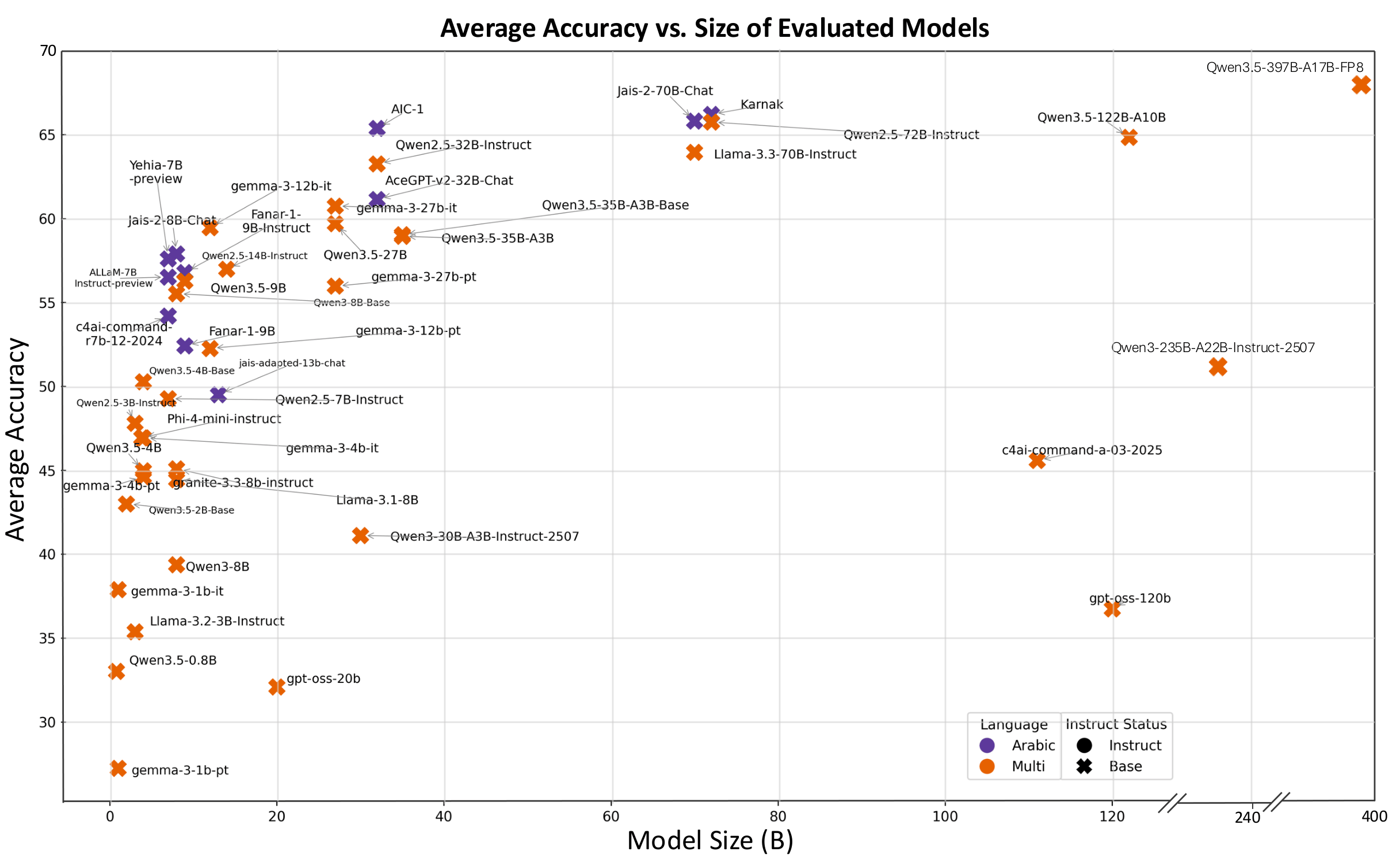
Arabic-specialized models often outperform size-matched multilingual models
Instruction-tuned models consistently outperform their base counterparts except for Qwen3
Some smaller Arabic-specialized models (Fanar-1-9B, ALLaM-7B) outperform much larger multilingual models on specific domains
🌟 What Makes QIMMA Different
To summarize the distinctive properties of QIMMA:
Property
Details
Quality-first philosophy
Validation runs before evaluation, not as an afterthought
Multi-model validation
Two LLMs with different training + human review for flagged cases
99% native Arabic
Avoids translation artifacts almost entirely
Multi-domain, multi-task
7 domains, 3 task types (MCQ, QA, code), 109 subsets
Code evaluation
First Arabic leaderboard to include code generation
Full transparency
Per-sample inference outputs publicly released, not just aggregate scores
LightEval-based
Unified, reproducible evaluation codebase
Dialectal awareness
Explicit handling of MSA vs. dialectal variation in prompts and rubrics
🔗 Resources
🏆 Leaderboard: QIMMA Leaderboard
💻 Code: GitHub
📄 Paper: Are Arabic Benchmarks Reliable? QIMMA's Quality-First Approach to LLM Evaluation
🔖 Citation
@misc{alqadi2026arabicbenchmarksreliableqimmas,
      title={Are Arabic Benchmarks Reliable? QIMMA's Quality-First Approach to LLM Evaluation},
      author={Leen AlQadi and Ahmed Alzubaidi and Mohammed Alyafeai and Hamza Alobeidli and Maitha Alhammadi and Shaikha Alsuwaidi and Omar Alkaabi and Basma El Amel Boussaha and Hakim Hacid},
      year={2026},
      eprint={2604.03395},
      archivePrefix={arXiv},
      primaryClass={cs.CL},
      url={https://arxiv.org/abs/2604.03395},
}